Thursday, June 12, 2025

What Was Jesus’ Message?


The four Gospels are very clear that Jesus’ primary message was about the Kingdom of God. Yet why is it so hard to find Jesus’ message in today’s Christianity?

The myriad of churches that make up Christianity profess that their religion is based on Jesus Christ. Nearly all claim Him as their founder and say that their teachings are based on what He said and did 2,000 years ago. But, sadly, there are many doctrines where mainstream Christianity ignores or actually rejects the teachings of Jesus Christ.

One major example of Christianity ignoring something Jesus plainly taught is His central message.

Here is a bold assertion: Mainstream Christianity almost entirely ignores the core message Jesus Christ brought when He walked the earth 2,000 years ago. But what was Jesus’ message?

His core message was the Kingdom of God.  

He pinpointed this central message in the heart of His most famous sermon—the Sermon on the Mount. He made a statement about what should be the highest priority for His followers: “But seek first the kingdom of God and His righteousness, and all these things shall be added to you” (Matthew 6:33, emphasis added).


Jesus Christ’s words are clear—the Kingdom of God is to be the No. 1 focus and emphasis in the lives of His followers. In fact, it was the core of His gospel message. Jesus’ gospel message was all about the Kingdom of God coming to this earth.

What is the gospel?

Gospel is a common word in the Christian world. Some think of it in connection with a genre of religious music, but in the Bible the word gospel describes a message. It literally means a message of good news.

Most churches include the word gospel in their mission statements. Typically, the gospel is described as the gospel of Jesus Christ, and it is seen as the message of His life, death and resurrection. (You can see this by doing a Google search of the mission statements of different denominations of Christianity.)

But was this the central message that Jesus actually taught? Was His message only about Himself?

A study of the Gospel accounts of Christ’s life pinpoints exactly what His message—His gospel—was all about!

Notice Mark 1:14: “Now after John was put in prison, Jesus came to Galilee preaching the gospel of the kingdom of God.” That statement is pretty plain—Jesus preached the gospel about the Kingdom of God!

There are many scriptures that reinforce this fact. For example, Matthew 9:35 says, “Then Jesus went about all the cities and villages, teaching in their synagogues, preaching the gospel of the kingdom.”

At one point in His ministry, Jesus was about to leave an area where He had been preaching for some time. The people of that area tried to persuade Him not to go (Luke 4:42). Jesus’ response was, “I must preach the kingdom of God to the other cities also, because for this purpose I have been sent” (verse 43).

Let that sink in.

Jesus Christ said that one of His primary purposes for coming to earth was to preach about the Kingdom of God! That was His gospel. That was His message. That was His purpose. That is what drove and motivated Him.

When we understand the thrust of Jesus’ message about the Kingdom of God, we understand better why He made the statement in Matthew 6:33: “Seek first the kingdom of God.” He tells us to seek first the Kingdom because the Kingdom of God was His primary message.

What was Jesus’ message? It was a message about the literal establishment of the Kingdom of God on earth at the second coming of Jesus Christ. See our infographic on this page to learn more details about what the Kingdom of God is.

Christians who seek to follow Jesus Christ’s footsteps should make the Kingdom of God as high a priority in their lives as it was in Christ’s life. Jesus came to set us an example of how to live. He then died for our sins and was resurrected so we can have an opportunity to be in the Kingdom of God.

Everything Jesus did during His earthly ministry ultimate leads to the Kingdom of God. That is why He summarized His message by calling it the gospel of the Kingdom of God.

But where is that message in mainstream Christianity today?
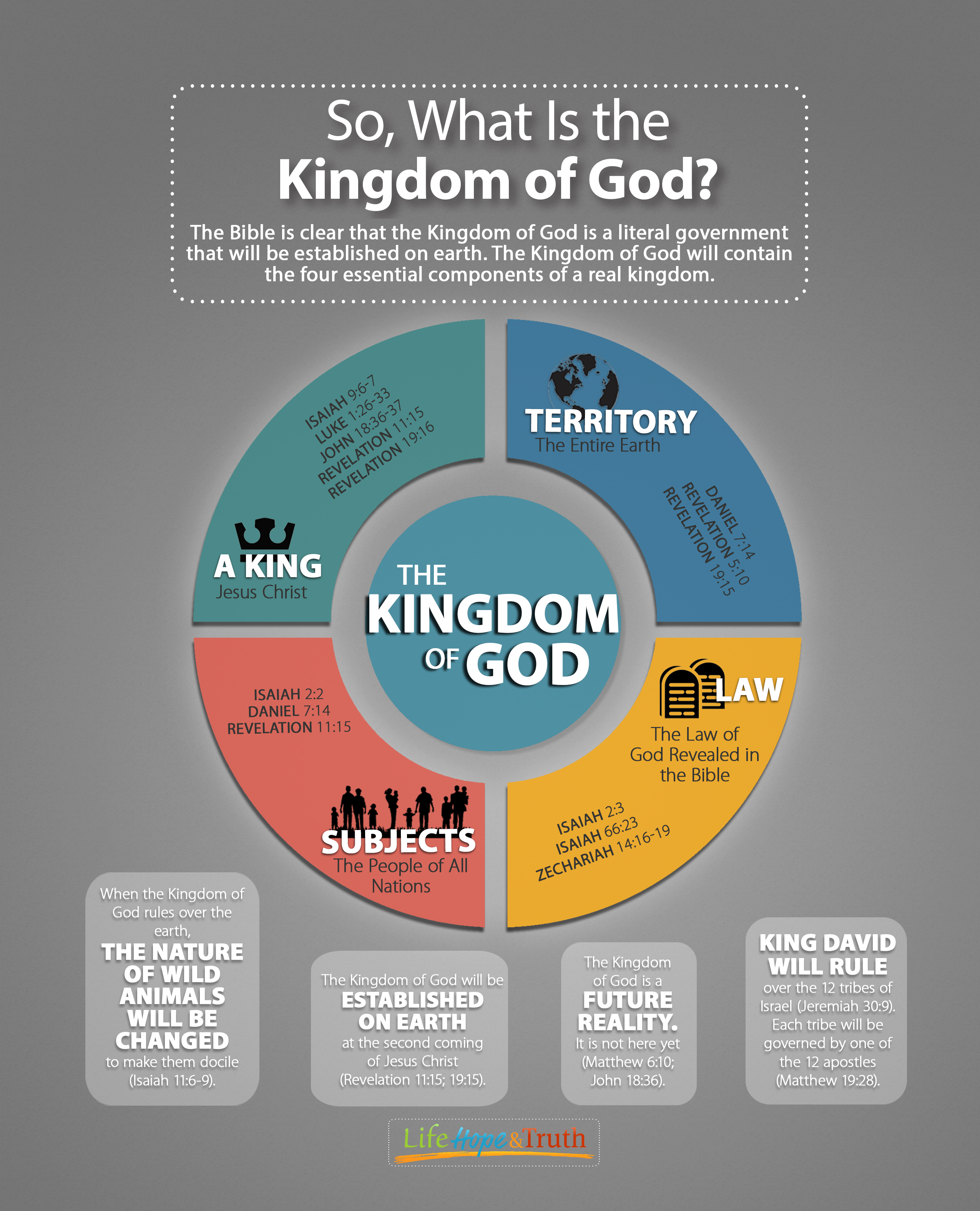
So, What Is the Kingdom of God?

Download infographic PDF

How Christianity lost Jesus’ message

After Christ was resurrected and ascended to heaven, He founded a Church. The purpose of that Church—that called-out group of people—was to carry on the work He did while on earth. Christ commissioned His Church to go into the entire world and preach the same message that He preached while He was on earth (Matthew 24:1428:19-20Mark 16:15Acts 1:3-8).

The Bible shows that the early Church faithfully followed Christ’s directive and preached the gospel of the Kingdom of God (Acts 8:1214:2219:820:2528:23, 31). The members of the early Church also put their focus on the coming Kingdom (Colossians 4:112 Thessalonians 1:5).

Jesus Christ’s words are clear—the Kingdom of God is to be the No. 1 focus and emphasis in the lives of His followers. In fact, it was the core of His gospel message.But as the first century progressed, the intense focus on the Kingdom began to wane as false beliefs began to creep into Christianity. The apostle Paul wrote that he perceived Christians in his time were “turning away” from the true gospel to “a different gospel” (Galatians 1:6).

In what was likely his final letter, Paul gave multiple warnings about his fear that people were abandoning true doctrines and being led astray into false teachings (2 Timothy 2:14-183:13-144:1-3, 14-15).

Other apostles wrote similar warnings (2 Peter 2:12 John 1:7Jude 1:4).

The understanding of the true gospel and the focus on the Kingdom of God were minimized and lost over the centuries after the end of the New Testament era.

A key factor in this was Emperor Constantine’s acceptance of a popular form of Christianity and its subsequent adoption as the official religion of the Roman Empire.

Historian Justo Gonzalez writes: “Since the time of Constantine, and due in part to the work of Eusebius and of many others of similar theological orientation, there was a tendency to set aside or to postpone the hope of the early church, that its Lord would return in the clouds to establish a Kingdom of peace and justice. … Eusebius, although more articulate than most, was simply expressing the common feeling among Christians, for whom the advent of Constantine and of the peace he brought about was the final triumph of Christianity over its enemies” (The Story of Christianity, Vol. 1, pp. 134-135).

This idea was also promoted by the theologian Augustine of Hippo in his highly influential book The City of God: “Therefore the Church even now is the kingdom of Christ, and the kingdom of heaven” (Book XX, Chapter 9).

This belief became known as amillenialism and is a dominant belief (in different forms) in mainstream Christianity today.

Amillenialism is the belief that there is no literal 1,000-year reign of the Kingdom of God on earth, but that Jesus is presently reigning over the earth through the Church. This was one of the major teachings that replaced Jesus’ true gospel throughout large portions of Christianity.

To learn more about what the Bible actually says about the Kingdom of God and the Millennium, read our article “1,000 Years—the Millennium.”

After the true biblical teaching of the Kingdom of God was removed, the gospel message was changed from the message about the Kingdom to a message primarily about Jesus Christ. In other words, Christianity kept the name of Jesus Christ, but abandoned His message.

Jesus was very clear that professing His name but ignoring His teachings is false worship (Luke 6:46). He wants His people to worship Him in “spirit and truth” (John 4:24).

Preaching the true gospel today

The true gospel message of Jesus Christ is not a minor issue. As we have already read, Jesus connected a belief in the true gospel to repentance (Mark 1:15), and the apostle Paul warned that preaching a different gospel brings a curse (Galatians 1:8-9). Believing the true gospel is vital to your salvation!

The true gospel is the message of good news about the coming Kingdom of God. It is a message of hope—for this entire world and for you and your family. It is the message that God is building a family that will soon rule the entire earth, bringing peace and happiness.

The established Christian churches have lost that true gospel message. Discern magazine and the Life, Hope & Truth website exist to continue the proclamation of the true gospel. Even though we are a minority voice in the world of religion, we are dedicated to teaching the same message that Jesus Christ taught.

We try to spread Jesus’ gospel message about the Kingdom of God as far and wide as possible. We want to help as many people as possible adopt Jesus’ message as the central focus of their lives. Seeking first the Kingdom of God can change your life in many ways!

You need to learn more about that true gospel message. We recommend reading our booklet The Mystery of the Kingdom.


Parables of Jesus


Jesus Christ often used parables to describe the Kingdom of God. What are the Kingdom parables, and why did Jesus employ them in His teaching?

A simple definition of a parable is a comparison between one thing and another. The International Standard Bible Encyclopedia gives a more detailed definition. A parable “ordinarily signifies an imaginary story, yet one that in its details could have actually transpired, the purpose of the story being to illustrate and inculcate some higher spiritual truth” (“Parable”).

It is interesting to note that parables had previously been used in the Old Testament (2 Samuel 12:1-4Isaiah 5:1-628:24-28). They were also employed in first-century Jewish literature.

But “the one and only teacher of parables in the New Testament is Christ Himself. The Epistles, although they often employ rhetorical allegories and similes, make absolutely no use of the parable, so common in Christ’s pedagogical methods. The distribution of these in the Canonical Gospels is unequal, and they are strictly confined to the three Synoptic Gospels [Matthew, Mark, Luke]” (ibid.).

As for the number of parables used by Christ, there are approximately 38. Different sources have different totals because not every parable is identified as such and because it is a somewhat subjective process to determine whether some parables are indeed different or if they are simply variations of a previously recorded parable.

As for the distribution of the parables within the synoptic Gospels, Matthew and Luke have the most; and Mark, the least. Each of these writers, however, has at least one parable unique to his book.

Why did Jesus use parables?

Many people believe that Jesus spoke in parables to simplify His message—to make it easily understood by all. Yet Christ said just the opposite.

Having been asked by His disciples why He used these comparisons of ordinary events to spiritual truths, He said, “Because it has been given to you to know the mysteries of the kingdom of heaven, but to them it has not been given” (Matthew 13:11, emphasis added throughout).

It's time to get to know God. Start your 7-day guided Journey.

Jesus added, “Therefore I speak to them in parables, because seeing they do not see, and hearing they do not hear, nor do they understand” (verse 13).

Jesus went on to explain that His method of teaching was a fulfillment of a prophecy given by Isaiah, stating that even though people would hear the truth of God, they would not comprehend its meaning (verses 14-15, compare Isaiah 6:9-10).

In other words, Jesus spoke in parables so people would not understand.

Not believing that Jesus would waste His time preaching and teaching in such a way as to block the comprehension of words that could lead to eternal life—the very purpose of His coming to earth (John 3:166:4010:10)—some have assumed that Jesus used parables to arouse people’s curiosity. They believe that since God loves the world and wants all to be saved (1 Timothy 2:4), Jesus was simply using a technique that would lead people into deeper study and subsequent understanding of His teachings. But such reasoning is mistaken. This reasoning is a fulfillment of Jesus’ own words that most people would not understand (Matthew 13:13).

In contrast to the majority of people who would not understand the meaning of the parables, Jesus told His disciples, “But blessed are your eyes for they see, and your ears for they hear” (verse 16). For those being called by God the Father (John 6:44, 65), the parables reveal profound spiritual truths. In that way, the parables of Jesus both conceal and reveal.


What most people today do not know is that God’s plan to allow humans to comprehend His truth and receive salvation takes place during different ages or periods of time. Put simply, this is not the only day of salvation. God the Father determines the age in which each individual will be given his or her opportunity to understand and respond to the gospel. To learn more about this astounding truth, see “Plan of Salvation.”

The primary theme of the parables

A brief sampling of how Jesus began many of His parables and how He spoke of them to His disciples reveals their primary theme. In the book of Matthew, the phrase “the kingdom of heaven is like” is a common introduction (Matthew 13:24, 31, 33).

In the book of Mark, the author explains that Jesus “taught them many things by parables” (Mark 4:2). When He was alone with His disciples, Jesus said, “To you it has been given to know the mystery of the kingdom of God; but to those who are outside, all things come in parables” (verse 11). Later, He said, “To what shall we liken the kingdom of God? Or with what parable shall we picture it?” (verse 30).

From these passages we see that the primary theme of Christ’s parables is the Kingdom of God. In these parables we learn what we must do to enter the Kingdom and what it will be like. This theme is consistent with the message He taught: “Jesus came to Galilee, preaching the gospel of the kingdom of God” (Mark 1:14) and His command to His followers: “But seek first the kingdom of God and His righteousness” (Matthew 6:33).

In addition to the parables that focus on concepts related to the Kingdom of God, others emphasize Christian living principles, such as mercy and who is one’s neighbor. Of course, we should also note that God expects us to develop these principles of Christian living in preparation for life in His Kingdom.

Interpretation of the parables

Since the primary theme of the parables is the Kingdom of God, we need to keep in mind that the comparisons made are to illustrate principles related to this coming kingdom. As for which details of a parable contain spiritual meaning, we must let Christ make the interpretations or let other passages of Scripture guide our understanding.

Since the primary theme of the parables is the Kingdom of God, we need to keep in mind that the comparisons made are to illustrate principles related to this coming kingdom. As for which details of a parable contain spiritual meaning, we must let Christ make the interpretations or let other passages of Scripture guide our understanding.It would be a mistake in interpretation to assume the parables introduce new doctrine not found elsewhere in the Bible or that they allow for unethical conduct (as in the parable of the unjust steward, Luke 16:1-8). This principle of not establishing doctrine via a parable is especially important in the interpretation of the parable of Lazarus and the rich man (Luke 16:19-31). For an explanation of this parable that is consistent with other biblical passages, see “Lazarus and the Rich Man.”

An important parable for us

While all of Christ’s parables contain important truths, one of His teachings provides an overall concept that is fitting as a conclusion to this article. This parable is about the pearl of great price.

Included among several parables focusing on the Kingdom of God, Jesus said, “Again, the kingdom of heaven is like a merchant seeking beautiful pearls, who, when he had found one pearl of great price, went and sold all that he had and bought it” (Matthew 13:45-46).

Just as the merchant placed great value on acquiring an expensive pearl, we need to likewise seek and value becoming part of the coming Kingdom of God. Seeking God and His righteousness needs to be our life’s most important quest.

To help you better understand the Kingdom of God and how you can be part of it, see the “Kingdom of God” and “Change” sections of this website.


How World Peace Will Come


Given the cruel, debilitating effects of war, man has often longed for peace. The Bible explains why it has been so elusive and how world peace will come.

City of Peace?

The city of Jerusalem presents what may be one of the greatest ironies in the world. Its name means “City of Peace,” and tourists and pilgrims can find the famous inscription “Pray for the peace of Jerusalem” (Psalm 122:6) in several places of biblical interest around the city. This inscription is found on monuments and plaques of more than one of the major religions.

Yet neither Jerusalem nor the world has ever experienced real, lasting peace. The city remains uneasy, a nexus of conflicting claims and competing religions. Its holy places—including the Dome of the Rock and the Western, or Wailing, Wall—are among the tensest places anywhere on earth.

And, according to the Bible, this city—and the entire world—will prove unable to find true peace in this age of human rule prior to the second coming of Jesus Christ the Messiah.

Why no peace?

Why? Why is it that a city that is so important to three major religions also finds itself the center of conflict? Wouldn’t one think that religious folk would be the best equipped to bring peace to that “city of peace” and to the world? Yet apparently that isn’t so.

God gave us the reason centuries ago through the prophet Isaiah: “The way of peace they have not known” (Isaiah 59:8).

What an apt characterization of this world and its weak attempts to bring peace to humanity. People pay lip service to the goal, but lack knowledge of the way to get there.

A clue as to why may be found in the four horsemen of the Apocalypse. It’s easy to miss the significance of the sequence of the horsemen. Notice that the first horse, the white one, goes forth “conquering and to conquer” (Revelation 6:1-2).

This first horseman resembles Jesus Christ, the King of Kings who will come back from heaven on a white horse (Revelation 19:11). Yet, in what seems to be a paradox to many, the rider of this horse doesn’t bring peace! Quite the contrary. It is this impostor, the false Christ, whose influence stokes the fires of war, suffering and destruction.

The second, red, horse “was granted … to take peace from the earth” and to cause people to kill one another (Revelation 6:3-4). There is a cause-and-effect factor here: The riding of the first horseman, symbolizing false religion and false philosophies, gives rise to the second—widespread war on the earth.

Is world peace possible?

How much war has there been in recent decades? The carnage is horrifying. Estimates of deaths due to war in the 20th century vary, but one source suggests 35 million human beings died in war during the 20th century (Democratic Peace Blog), while another offers a much higher figure of some 160 million (Scaruffi.com).

Whatever the exact figure, the 20th century proved to be the bloodiest in history, in spite of the efforts of the League of Nations and, later, of the United Nations. And the 21st century isn’t looking good either, as wars continue to smolder in places such as Syria, Afghanistan and Iraq.

Jeremiah summed it up well in a phrase that has made its way into common usage: “Saying, ‘Peace, peace!’ when there is no peace” (Jeremiah 6:14Jeremiah 8:11).

Every human effort to bring lasting peace has failed. If it depends on us, it seems world peace is impossible.

World peace will come only through the Prince of Peace

Simply stated, on its own humanity lacks the divinely revealed knowledge of how to bring peace. It is ultimately going to require the return to earth of Jesus Christ, and the setting up of the Kingdom of God, to bring true, just, lasting peace.

Notice this wonderful prophecy about the Messiah: “For unto us a Child is born, unto us a Son is given; and the government will be upon His shoulder. And His name will be called Wonderful, Counselor, Mighty God, Everlasting Father, Prince of Peace” (Isaiah 9:6, emphasis added).

He will bring with Him the administration of true justice and the pathway to real peace: “He shall judge between the nations, and rebuke many people; they shall beat their swords into plowshares, and their spears into pruning hooks; nation shall not lift up sword against nation, neither shall they learn war anymore” (Isaiah 2:4). That time is coming!

But how will this be accomplished? Should we expect this to come about simply by the efforts of national governments? Will the famous “swords-into-plowshares” statue that sits in front of the United Nations building in New York become a reality as a result of peace talks?

No, peace will not come about through peace talks

Many world leaders and diplomats have worked tirelessly to try to bring cease fires and peace treaties. But throughout history those efforts have eventually failed. Humans have proven powerless to bring real, lasting peace.

Instead of convening a peace conference, once Jesus Christ has returned to earth, He actually first will have to act swiftly and decisively to put down rebellion against His rule. We read of the aggressive action of the last world-ruling empire (one based in Europe) and its leader (one referred to as “the beast”) who “will make war with the Lamb, and the Lamb will overcome them, for He is Lord of lords and King of kings” (Revelation 17:8Revelation 17:14).

But this evil military campaign will not be successful. Rebellion against the righteous rule of the Messiah will be forcibly put down.

Then Jesus Christ will begin to introduce the elusive way of peace.

World peace will come, starting with Jerusalem

Under God’s inspiration, the prophet Zechariah gave us a beautiful description of the changed conditions in the city of Jerusalem under the Kingdom of God. “Old men and old women shall again sit in the streets of Jerusalem, each one with his staff in his hand because of great age. The streets of the city shall be full of boys and girls playing in its streets” (Zechariah 8:4-5).

Christ’s government, and the way of peace that it brings, will expand outward from Jerusalem and encompass the whole earth and its inhabitants.Both the aged and the young will then be free to enjoy the beauty and security of this, God’s capital city, with no fear of bombs or violence.

Once Jesus Christ has returned and set up His rule, peace will expand outward from the city of Jerusalem to finally bring rest to this war-weary world. “Of the increase of His government and peace there will be no end, upon the throne of David and over His kingdom, to order it and establish it with judgment and justice from that time forward, even forever. The zeal of the LORD of hosts will perform this” (Isaiah 9:7).

God’s government will bring world peace and security

God’s government of peace will be established, beginning with the city of Jerusalem. People will stream to that city to learn of God and His ways.

“Now it shall come to pass in the latter days, that the mountain of the LORD’s house shall be established on the top of the mountains, and shall be exalted above the hills; and peoples shall flow to it. Many nations shall come and say, ‘Come, and let us to up to the mountain of the LORD, to the house of the God of Jacob; He will teach us His ways, and we shall walk in His paths.’ For out of Zion the law shall go forth, and the word of the LORD from Jerusalem.

“He shall judge between many peoples, and rebuke strong nations afar off; they shall beat their swords into plowshares, and their spears into pruning hooks; nation shall not lift up sword against nation, neither shall they learn war anymore.

“But everyone shall sit under his vine and under his fig tree, and no one shall make them afraid; for the mouth of the LORD of hosts has spoken” (Micah 4:1-4).

The way of peace

No one will learn war, but everyone will have the chance to learn the way of peace—God’s way of love, expressed in His laws. Learn more about the way of peace in our article “The Way of Peace.”

Christ’s government, and the way of peace that it brings, will expand outward from Jerusalem and encompass the whole earth and its inhabitants. World peace will finally come.

A celebration of peace

These events are represented in the biblical Feast of Tabernacles, celebrated each year in the fall (in the northern hemisphere) by members of the Church of God. As one of God’s appointed festivals, it is an annual celebration of the soon-coming time of peace to be brought to earth, not by man’s efforts, but by the miraculous intervention of Almighty God. It provides a wonderful foretaste of the time of peace.

To learn more about this joyous biblical festival, we invite you to read the article about the Feast of Tabernacles on the LifeHopeandTruth.com website. Also, for more information, please see the article titled “1,000 Years: The Millennium.”

Yes, world peace really is coming. It will be a reality. And isn’t that good news?

To learn more about the coming Kingdom of God, which will usher in the peace humanity has longed for, see the articles in the section “The Kingdom of God.”


Neither Shall They Learn War Anymore


This phrase reflects a universal longing. But our world is addicted to ever more deadly war. How will the promise of peace really be fulfilled?

The irony was hard to miss, even for nonreligious people. Here was a militaristic, atheistic global power, bringing to the world a peace gift inspired by—of all things—the Bible.

It was 1959 when the Soviet Union presented to the United Nations a bronze statue of a brawny man wielding a hammer. With it, he was reshaping a weapon representing war and destruction, a sword, into a tool suggesting peace and goodness, a plow.

Coming from a regime that disdained the Bible, persecuted the religious and had recently slaughtered millions of its own citizens, Russia’s gesture rang hollow. But the words on this famous statue, “We Shall Beat Our Swords Into Plowshares,” strongly resonated in the hearts of people around the world, as they do to this day.

When accepting this gift, then Secretary-General Dag Hammarskjöld declared that “the ancient dream of mankind, reflected in the words of Isaiah,” was the same dream that had inspired the creation of the U.N.

The statue, regrettably, does not cite Isaiah’s exact words. But in a park across the street from the U.N. stands the “Isaiah Wall,” inscribed with more of the prophet’s quote: “They shall beat their swords into plowshares, and their spears into pruning hooks; nation shall not lift up sword against nation. Neither shall they learn war any more.”

World statesmen often quote this verse in speeches. Musicians set it to songs ranging from the stirring finale in Les Miserables to Michael Jackson’s “Heal the World.” And anyone who reads it can identify with it: “That’s the world I want!” Isaiah’s words beautifully encapsulate a universal longing.

Perfecting the art of war

But over 50 years and many wars later we must ask, Can that world ever become reality? Or is it the stuff of whimsical dreams? Is it even remotely possible for us to find our way to Isaiah’s world when, as General Omar Bradley put it, “ours is a world of nuclear giants and ethical infants”? He added sadly, “We know more about war than we know about peace, more about killing than we know about living.”

Is the truth as fatalistic as Cormac McCarthy portrayed it in his novel Blood Meridian? “It makes no difference what men think of war. … War endures. As well ask men what they think of stone. War was always here. Before man was, war waited for him. The ultimate trade awaiting its ultimate practitioner. That is the way it was and will be” (1985).

Given our history, it seems to many that he’s right.

Man stumbled upon violence accidentally, biblical history shows, and it didn’t take us long! Adam and Eve’s son Cain, in a fit of jealousy, “rose up against Abel his brother and killed him.” Whatever he used—a rock, a limb, his fists?—Cain ignited humanity’s most dreadful plague, people rising up and killing one another. His wickedness stemmed from an emotional outburst, but those who followed quickly began studiously perfecting the art of war, devising the most efficient, destructive means possible.

And painful and repulsive as war is, we remain stumped in our quest to perfect the art of peace.

Changing the “seed-bed”

Lawrence LeShan is on to something, though, when he notes in his book The Psychology of War: Comprehending Its Mystique and Its Madness: “We must not ask, ‘What events led to the outbreak of this war or that one?’, but rather, ‘What is there in man that makes him so ready to go to war, in almost all cultures or economic conditions?’ The question we are dealing with here concerns the readiness, the receptivity, the seed-bed on which specific events fall and which, when nourished by it, flower into armed intergroup conflict” (2002, p. 109).

It’s clear to most people that the “seed-bed” of human thinking has to change. But how?

We come so close to the answer in Isaiah’s words etched on the wall near the U.N., but we miss it by a mile when we fail to read the rest of what he wrote. Those statues and songs rush to portray the beautiful end result of Isaiah’s ideal world, but they neglect to consider what precedes it.

Only in the rest of Isaiah’s words do we see the backstory that is crucial to understanding what will lead to walking away from war.

The prerequisites of peace

Isaiah begins by establishing the setting in which the only possibility of a warless world can take place: “Now it shall come to pass in the latter days that the mountain [government, in prophetic terms] of the Lord’s house shall be established on the top of the mountains [other human governments], and shall be exalted above the hills; and all nations shall flow to it” (Isaiah 2:2).

Fact one: World peace will never happen without Jesus Christ coming to the earth to establish the Kingdom of God over which He will reign as King of Kings. Bible prophecies center squarely on that event. Jesus warned that we will eventually teeter on the verge of destroying ourselves, but He won’t let that happen (Matthew 24:21-22). What next, though?

After He returns, people all over the world will say, “He will teach us His ways, and we shall walk in His paths.” What prompts this turning to God? “For out of Zion shall go forth the law, and the word of the Lord from Jerusalem” (Isaiah 2:3).

The little word “for” is quite important. It means “because” or as a consequence.

Fact two: The desire people have to learn from God arises because His law and word first go forth. The knowledge He gives stirs in them a longing to learn more. Finally they’re grasping how the “seed-bed” of human thinking works and why it can be so destructive.

Notice the beginning of verse 4, which is omitted from most artistic depictions of the “swords into plowshares” concept! “He shall judge between the nations, and shall rebuke many people.” This is a key statement—what is it telling us?

Fact three: Turning from war comes because of being judged and rebuked! God’s judgment here is not sentencing people to their fate. It is judgment clearly designed to help people comprehend their need to correct their futile, humanly devised ways, laws, paths and thoughts.

Along with judgment inevitably comes being “rebuked,” or convicted, convinced, corrected. Surely common sense tells us that something about the way we live desperately needs to be corrected!

By the nature of this process, the “swords into plowshares” scenario cannot happen overnight. People won’t immediately reject war when Christ returns, because they will first have to reject their way of thinking—the only way they’ve ever known. Rejecting one way of thinking depends on replacing it entirely with another.

War will only be rejected when a new way is accepted—God’s ways, His laws, His thoughts.

But He tells us, through Isaiah, it will happen!

Beating swords into plowshares is a wonderful metaphor describing a widespread physical response that will spring from a spiritual understanding. If we want world peace, we cannot exclude these spiritual prerequisites. We can’t erect statues and etch upon them partial sections of verse—but exclude the principles we must follow to find peace! Pretending we can make it happen without Christ returning and totally reshaping the way we think is delusional, if not self-righteous.

The heart of the matter

Centuries after Isaiah, another biblical writer elaborated further. The apostle James posed in the simplest of terms a core question all humans need to face: “Where do wars and fights come from among you?” (James 4:1). We tend, as LeShan noted, to answer with various events that trigger wars. But James went straight to the heart of the matter—each person’s heart.

How many wars have originated in religion, with all involved beseeching favor from God as the combatants kill one another? God will never answer when the spirit and motive are so wrong!Wars and fights are symptoms of a deeper problem. “Do they not come,” he said, “from your desires for pleasure that war in your members [battle within you, New International Version]?”

Desire (or lust, as it’s also rendered) means that which pleases the senses, or suits one’s desire or pleasure. It includes the things that commonly motivate us, such as power, glory, position, wealth, dominance or simply just wanting our own way. All of these spring from self-centeredness. These things light the fuses of the worst human behavior.

James continues to describe the war in the mind: “You lust and do not have. You murder and covet and cannot obtain. You fight and war. Yet you do not have because you do not ask. You ask and do not receive, because you ask amiss, that you may spend it on your pleasures” (verses 2-3).

His point is simple: War is born from personal or national self-seeking, self-interest, self-aggrandizement. Until the self is conquered, war remains unconquered. Even asking things from others or from God is commonly selfish. How many wars have originated in religion, with all involved beseeching favor from God as the combatants kill one another? God will never answer when the spirit and motive are so wrong!

But James isn’t finished. He confronts us with another essential question: “Adulterers and adulteresses”—anyone claiming a spiritual relationship with God yet breaking the covenant—“do you not know that friendship with the world is enmity with God?”

Based on humanity’s track record, the answer is no. We don’t know how and why the world’s way is enmity with God. Fighting and warring on any level—in marriage and family, with neighbors, or among nations—follows the way of an ungodly world, not God. It stems from problems in the human heart, spiritual problems. And spiritual problems are rooted in rejecting God’s way of life.

James continually steers us back to this truth, never letting us excuse our way out of it. Conflicts may be acted out between humans, but the root problem is that we have first rejected God!

The solution is simple, though not easy for humans: “Submit to God,” “draw near to God,” “cleanse your hands” (repent and change), “purify your hearts, you double-minded” (verses 7-8). “Lament and mourn and weep,” meaning to genuinely be sorrowful, and “humble yourselves in the sight of the Lord” (verses 9-10).

Humans always resist that path, but it is truly the only path to peace. When we choose to walk that way, it is promised, “He will lift you up.”

Peace with God, then peace with man

So, is James too simplistic, or do his words simply cut to the heart of the matter? Actually, these are words inspired by God, and God is clear: Wars between people will cease only when we first end our war with Him!

When Christ returns, He will convince people that “the problem is not between you and this person or your nation and that one—the problem is between you and Me!” He will require each of us to confront the reality of our own nature—the self-centeredness that generates all that is wrong in our actions.

And as each of us accepts God’s righteous sovereignty, humbly seeks His forgiveness and help, changes the thoughts and intents of our hearts, and starts obeying His laws—the things that make for peace with our Creator—then we will finally find our way to making peace with our fellow man.

What about now?

Can we stop war and fighting now, on a worldwide basis? No. Christ must return; God’s Kingdom must come—and that’s the first thing Jesus told us to pray for (Matthew 6:10).

But can we live the way of peace on an individual basis? Yes! The second thing He said to pray for was, “Your will be done on earth as it is in heaven.” You have the opportunity now to choose to learn and do God’s will. You can understand His will and His way; you can turn away from self-will; and you can make peace with Him—if you are willing!

And that new world Isaiah wrote about? Well, you can read about it now, but even better than that, God says you can be there with Jesus Christ to usher it in—a wonderful world where “nation shall not lift up sword against nation, neither shall they learn war anymore.”

You can learn more about the way to peace in the articles “The Way of Peace” and “World Peace: How Will It Come?


A Believers Body As A Temple

  1 Corinthians 3:16-17 Do you not know that you are a temple of God and that the Spirit of God dwells in you? If any man destroys the templ...