Tuesday, August 5, 2025

“Help My Unbelief”


Faced with trials—from poor health to financial worries—many Christians find their faith can falter. Are there ways you can build your faith?

One of the most poignant stories in the Gospels involves a father stretched to the point of despair because his son was possessed by an evil spirit. He had asked the disciples of Jesus to heal his son, but they couldn’t.

When Jesus appeared on the scene, the father turned to Him, saying, “If You can do anything, have compassion on us and help us” (Mark 9:22). Jesus then told the father that “all things are possible to him who believes” (verse 23).

In response, the father blurted out that he believed.

And then he added a plea to Jesus Christ: “Help my unbelief!”

This story and its seeming contradictions resonate with many Christians.

That’s because we believe in the power and love of God, but when faced with trial, we sometimes find that our faith is not as strong as we had initially thought.

This article will look at five specific ways you can build your faith.

1. Ask God to increase your faith

When the father in Mark 9 said, “I believe; help my unbelief,” he was not contradicting himself. He was merely acknowledging the limits of his faith. Note that Jesus did not rebuke this distraught father when he asked for help to believe at a deeper level. Instead, He cast the demon out of the man’s son.

Christians may be hesitant to ask for faith because the New Testament so often condemns a lack of faith. In fact, in Matthew’s account of the same incident, Jesus twice rebuked the disciples: when He first learned they had failed to cast out the demon, and again when they asked why they had failed (Matthew 17:16-17, 19-20).

The difference between the disciples and this father is that the disciples had been with Jesus, and they had even been given the power to cast out demons. They should have had the faith to perform the task.

The father, on the other hand, had not had access to Jesus in the same way. His belief was strong enough that he took his son to the disciples. Later, when they failed, he had the courage to ask Jesus for greater faith.

In what is often called the Sermon on the Mount, Jesus encouraged those who listened to Him by comparing our Heavenly Father to human fathers: “If you then, being evil, know how to give good gifts to your children, how much more will your Father who is in heaven give good things to those who ask Him!” (Matthew 7:11).

There is no doubt that faith in God is a good thing! So the first way to build your faith is to ask for more.

2. Understand that God loves you

Ultimately, our faith rests on the love of God. A failure to appreciate God’s love for us can be one of the biggest obstacles to our faith.

We become Christians when we truly see who God is and who we are. We see our sins, and we repent. We understand that Christ’s blood paid for our sins. But could God actually love us—as individuals?

Articles relevant to your life.

The apostle Paul grappled with this issue in his letter to the Romans. He recognized sin in his own life and how difficult it is to live a godly life: “For I know that in me (that is, in my flesh) nothing good dwells; for to will is present with me, but how to perform what is good I do not find. For the good that I will to do, I do not do; but the evil I will not to do, that I practice” (Romans 7:18-19).

Anyone who has lived long as a Christian, struggling against the ways of this world, can relate. The trouble is, the more we see how wretched we really are, the more we may secretly wonder how God could love such a sinner.

Fortunately, some of Paul’s most encouraging words come at the end of the very next chapter: “For I am persuaded that neither death nor life, nor angels nor principalities nor powers, nor things present nor things to come, nor height nor depth, nor any other created thing, shall be able to separate us from the love of God which is in Christ Jesus our Lord” (Romans 8:38-39).

When we come to understand that God loves us—not because of who we are, but because of who He is—then we come to a deeper trust. Seeing God’s love builds our faith.

3. Establish a deeper relationship with God

After Jesus had cast the demon out, and after they had left the crowd, His disciples asked Him why they had failed. After all, He had granted them authority to cast out demons (Mark 6:7, 13). Jesus explained that “this kind can come out by nothing but prayer and fasting” (Mark 9:29).

Looking back through Jesus’ encounter with the distraught father, we can see that there is no mention of Jesus praying immediately before casting out the demon. He merely rebuked the spirit, commanding it to depart (verse 25).

So why did Jesus tell His disciples that “this kind can come out by nothing but prayer and fasting”?

The inclusion of fasting in His statement indicates that He was probably not speaking of prayer immediately beforehand. He was speaking of a life characterized by prayer and fasting. He was speaking of having a strong relationship with God.

One of the core teachings of the Bible is that having a genuine relationship with God is critical. God is not a genie, granting wishes on command. He is our Father, and we have been called to be His children. That means we should be spending time in prayer on a regular basis, not only when there is an emergency in our lives!

As we come to know God through Bible study, humble ourselves through fasting, and speak our hearts through prayer, we develop our relationship with God. And the closer we draw to God, the greater our faith will be.

4. Focus on God, not on your trials

If you want to defeat unbelief and increase your faith, shift your focus from the problems of life to the God of all power!A fourth way to defeat unbelief involves a matter of perspective. When we face some difficult trial in life, it’s easy for us to be overwhelmed. All we can see before us is an enormous problem. We become convinced that there is no solution because we, personally, have no way to overcome the challenge.

We must consciously shift our focus from the problem to our God. When the Egyptian army pursued the tribes of Israel, trapping them at the Red Sea, the people cried out in alarm and despair. Moses told them to shift their focus: “Stand still, and see the salvation of the LORD” (Exodus 14:13).

One of the best examples of the role that focus plays in our faith is of Peter and Jesus on the Sea of Galilee (Matthew 14:22-33). The disciples, who were crossing the Sea of Galilee ahead of Christ, were startled and frightened when they saw Him walking on the water toward them.

After Jesus reassured them, Peter boldly asked Jesus to command him to walk on the water as well. Jesus said, “Come,” and Peter, focused on Christ, actually walked on water. Peter is the only human besides Jesus who walked on water!

Then, Peter shifted his focus away from Jesus to the storm itself. The Gospel account clearly tells us the reason: “But when he saw that the wind was boisterous, he was afraid; and beginning to sink he cried out, saying, ‘Lord, save me!’” (verse 30).

If you want to defeat unbelief and increase your faith, shift your focus from the problems of life to the God of all power!

5. Remember why you are called

A final point to consider is our purpose in life. As Christians, we have a mission, and that may require sacrifice at times. All God’s servants, though blessed in many ways, must endure hard times.

In fact, the apostle Paul makes a sobering statement in one of his letters to Timothy: “Yes, and all who desire to live godly in Christ Jesus will suffer persecution” (2 Timothy 3:12). If you are a true Christian, you can expect troubles. Understanding what the Christian calling means can help us prepare for these times.

So many of God’s servants have endured great trials, and many have given their lives. At times, this sacrifice may be for the benefit of others. That may well have been the case with Stephen, who was brutally stoned (Acts 7).

Saul, who later took the name Paul, consented to that stoning (Acts 8:1). Ultimately, Paul became a zealous tool in God’s hands, taking the gospel to the gentile world. The role he had played in the deaths of early Christians (1 Corinthians 15:9) undoubtedly drove this apostle as he himself was beaten, stoned and shipwrecked (2 Corinthians 11:25).

Understanding God’s greater purpose and our purpose in life can help us build faith. Paul reassures us that we will never face trials greater than we can handle (1 Corinthians 10:13). And, like Paul, we can confidently state, “I can do all things through Christ who strengthens me” (Philippians 4:13).

To study this further, see our online article “How to Grow in Faith.”


“You of Little Faith”


What can we learn from the times when Jesus chided His disciples for their little faith? And from the examples of “great faith” He highlighted as well?

“You of little faith.” Those words from our Lord and Savior must have stung His disciples deeply.

After all, they had given up everything to follow Him. They trusted Him enough to leave behind their former jobs and security. They had seen His miracles and believed His teachings.

Yet it was true. Jesus knew that they still had little faith—that they needed to grow in faith.

“You of little faith, why did you doubt?”

One of the most memorable miracles in the Bible is when Jesus walked on water.

It was night, and the disciples were out in the middle of the Sea of Galilee in a boat tossed by the waves. Then, suddenly, they thought they saw someone or something walking on the water! They cried out in fear.

But Jesus said, “Be of good cheer! It is I; do not be afraid” (Matthew 14:27).

Then Peter said something that I don’t think would have ever occurred to me to say: “Lord, if it is You, command me to come to You on the water” (verse 28).

“So He said, ‘Come.’ And when Peter had come down out of the boat, he walked on the water to go to Jesus.

“But when he saw that the wind was boisterous, he was afraid; and beginning to sink he cried out, saying, ‘Lord, save me!’

“And immediately Jesus stretched out His hand and caught him, and said to him, ‘O you of little faith, why did you doubt?’” (verses 29-31).

Face it. It would have taken quite a bit of faith to step over the side of the boat onto water! Peter had never been able to walk on water before, so he was demonstrating his belief in Jesus’ power to allow him to do it now.

He showed faith.

Until he didn’t. His faith was temporary and quickly disturbed by the boisterous wind.

Still, Peter knew where to turn for help. His faith may have been little, but it was pointed in the right direction.

“Why are you fearful, O you of little faith?”

Jesus knew His disciples were still growing in faith. But perhaps He had hoped they would have had more at that point.The Sea of Galilee also played a role in an earlier example when Jesus chided His disciples for a lack of faith.

In this case, Jesus was also in the boat.

“And suddenly a great tempest arose on the sea, so that the boat was covered with the waves. But He was asleep.

“Then His disciples came to Him and awoke Him, saying, ‘Lord, save us! We are perishing!’

“But He said to them, ‘Why are you fearful, O you of little faith?’ Then He arose and rebuked the winds and the sea, and there was a great calm” (Matthew 8:24-26).

Parallel accounts may give us more insight. In Luke 8:25 Jesus asked, “Where is your faith?” And in Mark 4:40 He said, “How is it that you have no faith?” or, “Do you still have no faith?” (New International Version).

Jesus knew His disciples were still growing in faith. But perhaps He had hoped they would have had more at that point.

Examples of great faith

Earlier in Matthew 8 Jesus highlighted a contrasting story of great faith. A centurion, an important officer in the Roman army, pleaded with Jesus to heal his servant.

It's time to get to know God. Start your 7-day guided Journey.

Jesus was willing to come, but the centurion humbly said, “Lord, I am not worthy that You should come under my roof. But only speak a word, and my servant will be healed” (verse 8).

This military man recognized that just as he could order his soldiers to go do something, Jesus could command a healing from afar. He understood that Jesus’ power to heal was not limited by physical distance.

“When Jesus heard it, He marveled, and said to those who followed, ‘Assuredly, I say to you, I have not found such great faith, not even in Israel!’” (verse 10; also recounted in Luke 7:9).

“O woman, great is your faith!”

Matthew and Mark also tell about the time Jesus and His disciples traveled to the gentile region of Tyre and Sidon to try to get away from the constant press of the crowds. Jesus tried to avoid attention, but somehow a woman from the area found Him.

She kept crying out, “Have mercy on me, O Lord, Son of David! My daughter is severely demon-possessed” (Matthew 15:22).

This made things difficult, because Jesus’ specific mission then was to go to the “lost sheep of the house of Israel” (verse 24). The gentiles’ time would be later.

But the woman kept pleading.

What Jesus said next was said in love, but it certainly had the potential to offend her. He explained, “It is not good to take the children’s bread and throw it to the little dogs” (verse 26).

Instead of allowing this to offend her, she humbly and wisely replied, “Yes, Lord, yet even the little dogs eat the crumbs which fall from their masters’ table” (verse 27).

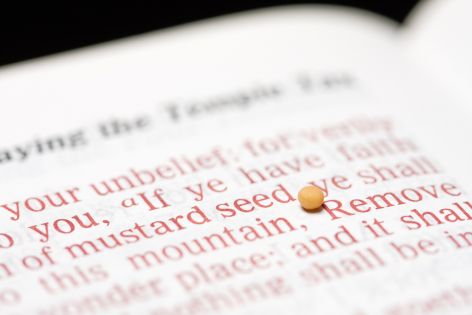
<p>Jesus chided the disciples when they showed little faith, but He also said that faith as small as a mustard seed had the power to move mountains (Matthew 17:20). We are encouraged to grow in faith.</p>

Jesus chided the disciples when they showed little faith, but He also said that faith as small as a mustard seed had the power to move mountains (Matthew 17:20). We are encouraged to grow in faith.

Jesus was impressed with her belief in His healing power and His love. Hers was a faith willing to reason with God, but unwilling to be offended or to question God’s love and fairness.

“Then Jesus answered and said to her, ‘O woman, great is your faith! Let it be to you as you desire.’ And her daughter was healed from that very hour” (verse 28).

Some lessons about faith

These memorable examples of little faith and great faith can teach us some lessons:

Faith is very important to God. Jesus was disappointed by His disciples’ lack of faith, and He was impressed by the great faith of the centurion and the Syrophoenician woman. Hebrews 11:6 tells us: “Without faith it is impossible to please Him.”

Jesus even asked this question: “When the Son of Man comes, will He really find faith on the earth?” (Luke 18:8). The clear implication is that He wants to find faith, and so we must strive to grow in faith.

Don’t make assumptions about other people’s faith. It would have seemed logical to expect Jesus’ disciples to have had the most faith, and for those from gentile nations who didn’t grow up knowing the God of the Bible to have had less faith. But these stories turn those expectations on their heads.

If the disciples needed to grow in faith, so probably do we. After many tests of faith and after receiving the power of the Holy Spirit and growing in the fruit of the Spirit, the disciples displayed strong faith.

For example, Peter preached powerful sermons and stood up to the rulers who commanded him not to preach in Jesus’ name (Acts 2-4).

We, too, can ask for God’s help and study what the Bible says about how to grow in faith.

Growing in faith

For a practical Bible study on growing in faith, see our article “How to Grow in Faith” and related articles.


Is Your Faith Misplaced?


Does faith mean we believe that God will answer our prayers exactly as we asked? Or does faith in God mean accepting His answer, whatever it is?

With a stern face, the most powerful man in the known world warned the three young Jews not to disobey him. As they stood before his throne, he told them that, should they continue to refuse to worship the 90-foot image he had built, they would face a horrifying death—being burned alive in a massive furnace (Daniel 3:15).

Shadrach, Meshach and Abed-Nego calmly refused the order of the Babylonian king, demonstrating remarkable faith in the true God. This dramatic story offers important insights into the nature of true faith.

But if not . . .

In their reply to Nebuchadnezzar, the three young Jews confirmed their belief that the God they worshipped was fully capable of delivering them from certain death (verse 17). They even expressed belief that God would deliver them. Both of these assertions refuted the king’s arrogant rhetorical question, “And who is the god who will deliver you from my hands?”

Shadrach, Meshach and Abed-Nego followed up, however, with a startling statement:

“But if not, let it be known to you, O king, that we do not serve your gods, nor will we worship the gold image which you have set up” (verse 18).

Notice the first three words: “But if not.” At first glance, the reader might wonder whether these Jews were wavering. Yet the resolute declaration lets us know they were not suffering a lack of faith. So what are we to make of their admission that God might not intervene?

Faith or faithfulness?

First, we must consider what faith is. You won’t find the word faith anywhere in Daniel 3, even though this passage contains one of the greatest examples of faith. In fact, the word faith appears only twice in the entire Old Testament (King James Version). And the Hebrew in those two passages can be translated faithful or faithfulness instead.

Actually, words translated faithfulfaithfully or faithfulness appear more than 50 times in the Old Testament (KJV). Clearly, the Old Testament emphasizes faithfulness over faith. How God’s people respond to God’s commands and how God fulfills His covenant promises are the measure of faithfulness.

Unlike the Old Testament, the New Testament does bring up faith (Greek pistis) extensively. Vine’s Complete Expository Dictionary notes that the word, as used in the New Testament, always refers to faith in God or Christ.

Refusing to worship Nebuchadnezzar’s giant image reflected the faithfulness of Shadrach, Meshach and Abed-Nego, who faithfully obeyed the Second Commandment prohibiting veneration of idols. It also reflected their faith, as defined in New Testament terms.

Hebrews 11, nicknamed the Faith Chapter, confirms this. The chapter almost certainly refers to Shadrach, Meshach and Abed-Nego when it speaks of individuals who “quenched the violence of fire” (verse 34).

The true nature of faith

The apostle Paul wrote, “The just shall live by faith” (Romans 1:17Galatians 3:11), quoting Habakkuk 2:4. However, the word translated faith in this Old Testament passage is one of the two verses mentioned earlier in this article. The word faithfulness would be a better translation.

The Expositor’s Bible Commentary, in discussing this clause, explains, “The discrepancy between ‘faith’ and ‘faithfulness’ is more apparent than real, however. For man to be faithful in righteousness entails dependent trust in relation to God.”

Not receiving the answer we want does not automatically mean we lack faith. But disillusionment with God’s answer might be a sign of misplaced faith.Faith and faithfulness are interwoven, because both are based on our relationship with God. Both concepts are based on a covenant, or agreement, between God and His people. We agree to obey, and He agrees to provide, to protect and to bless.

And this understanding brings us back to our question about Shadrach, Meshach and Abed-Nego. How could they admit that God might not deliver them and yet remain resolute in refusing to obey the king’s command?

The object of our faith

The three young Jews in Daniel 3 put their faith in God, not in a specific response to their crisis. They obeyed God, refusing to break His law by bowing down to the image Nebuchadnezzar had created. They were faithful.

Because they were faithful, they could also have a real faith that God would honor His own covenant promises. They could say, “Our God whom we serve is able to deliver us from the burning fiery furnace” (Daniel 3:17). They could also say, “He will deliver us from your hand, O king.”

And when they added, “But if not,” they showed they had faith in God, regardless of what happened next.

Is your faith misplaced?

So, is your faith misplaced? Have you put your faith in something other than God Himself?

As a Christian, you face the potential for disillusionment and disappointment if you have faith that God will heal you, or give you a better job, or provide you a mate. God might very well do any and all those things when we ask. But He might not!

Not receiving the answer we want does not automatically mean we lack faith. But disillusionment with God’s answer might be a sign of misplaced faith.

Like Shadrach, Meshach and Abed-Nego, you must put your faith in God alone—in His character, His power, His promises and His love—knowing that He can do any of those things you ask. At the same time, you must say in your heart, “But if not,” I will still trust in God. Or as Jesus put it, “Not My will, but Yours, be done” (Luke 22:42).

To understand more about what the Bible says about answered prayer, see “Five Keys to Answered Prayers.”


Bones of Joseph: Lesson of Faith


Hebrews 11 highlights a lesson of faith from the life of Joseph, who “gave instructions concerning his bones.” What can we learn from the bones of Joseph?

There are several lessons or principles recorded in the Bible relating to bones. Perhaps the best known is the valley of dry bones in Ezekiel 37.

However, there is another account about bones with a profound spiritual lesson for Christians. It involves the patriarch Joseph.

Character study of Joseph in the Bible

Most are familiar with the inspiring story of Joseph found in the book of Genesis. Chapter 37 begins the account showing young Joseph as the favorite son of his father, Jacob. God chose Joseph for a special purpose, but Joseph naively thought the rest of the family would be pleased to hear about his dreams (Genesis 37:5).

In reading the story of Joseph’s life, we come to admire his courage, his industry and stewardship as Potiphar’s servant, his resistance to temptation, his perseverance in prison, his willingness to forgive his brothers without seeking revenge, his love for his father, as well as other admirable traits.

The happy ending provides for uplifting reading, and the story is one of the great human interest accounts in the Bible. Joseph modeled the meaning of godly character.

An act of faith

However, when asked what they admire most about this great biblical character, most people don’t mention what was perhaps his greatest underlying quality.

Joseph is spoken of favorably in the New Testament book of Hebrews. Yet Hebrews 11 refers to only one deed as an example of his godly faith, and it is not included in the traits that are commonly mentioned in connection with his life. The example of the faith of Joseph that was noteworthy enough to be mentioned in the Faith Chapter of the Bible has to do with his bones.

“By faith, Joseph dying remembered concerning the Exodus of the sons of Israel and gave orders concerning his bones” (Hebrews 11:22, Modern King James Version throughout).

Hebrews 11 extols Joseph’s faith not by listing any of the noteworthy character traits he exhibited during his active lifetime, but by what he requested when his death drew near. We read his expression of faith in Genesis 50:24-25.

“And Joseph said to his brothers, I die. And God will surely visit you, and bring you out of this land into the land which He swore to Abraham, to Isaac, and to Jacob. And Joseph took an oath of the sons of Israel, saying, God will surely visit you, and you shall carry up my bones from here.”

Bones of Joseph in The Ten Commandments movie

People generally are not too concerned about what happens to their bones after death. Yes, they may have a desire to be buried in a hometown or next to loved ones, but those are not expressions of religious faith but of sentimental preference for one’s remains.

What was so special about Joseph’s request that the author of Hebrews was prompted to include it among other profound acts of faith?

Many reading this article have seen the famous Cecil B. DeMille movie The Ten Commandments, starring Charlton Heston as Moses. There is one dramatic, panoramic scene of the children of Israel leaving Egypt with their young and old, with their sons and daughters, and with their flocks and herds (Exodus 10:9).

Included in the depiction of this exodus was a type of procession with Aaron and the elders carrying the bones of Joseph while chanting in solemn, melodic tones, “Jacob cherished his son Joseph; many colors was his coat.”

It was the movie’s portrayal of how Joseph’s earnest request, made many years earlier, was honored by the nation. God had delivered them, just as Joseph had declared, and out of great respect they were taking his bones to the Promised Land.

Lessons of faith

There is much to learn from this unique biblical account of the bones of Joseph.

Joseph attained great prominence, wealth and authority in Egypt. Yet, although he had achieved enormous success and status, he never lost sight of God or His promises. His wealth and station did not corrupt his faith or cloud his vision of God’s plan. Joseph lived and worked in Egypt, but in spirit he dwelt in the Promised Land.

Requesting of his family that his bones be taken to the Promised Land tells us that Joseph was faithfully walking with God right up until his death.Requesting of his family that his bones be taken to the Promised Land tells us that Joseph was faithfully walking with God right up until his death. He had a position second only to Pharaoh in the Egyptian government (Genesis 41:44), but throughout his life, he was first subject to the government of God and the laws of the Kingdom of God (Genesis 39:9).

Vision of faith

Joseph is a great example for each of us. Christians have not been promised a physical Promised Land, but a spiritual Promised Land, the Kingdom of God (1 Corinthians 15:50). Though we have important responsibilities to fulfill with respect to our family, nation, neighbors and ourselves, our minds are to be focused on the Kingdom of God and what God promises is ahead.

It is very easy, especially during times of trial, to get caught up in the everyday pressures and concerns of this life so that the vision of the Kingdom of God begins to fade. But a Christian is called out of this world, and we are primarily to set our affections on things above (Colossians 3:2) not on the things of this world. That takes a continual renewal of our faith through the help of God’s Spirit.

Faithful servants of the Faith Chapter

Other individuals mentioned in Hebrews 11 had the same perspective as Joseph. Like Joseph, they died without entering God’s Promised Land, yet they saw it afar off.

“These all died by way of faith, not having received the promises, but having seen them afar off. And they were persuaded of them and embraced them and confessed that they were strangers and pilgrims on the earth” (Hebrews 11:13).

Like Joseph, they always put God’s plan for them first in their hearts and minds. Like Joseph, they had a vision of something beyond their present circumstances, so God was not ashamed to call them His own people (Hebrews 11:16).

A Christian is first and foremost a citizen of the Kingdom of God (Philippians 3:20). We live by the values and principles of God’s government under all circumstances.

That is not how the world around us thinks. People generally justify their behavior based on the situation or circumstances they are presently facing, not on the spiritual laws of God. We all need to seek God’s help and continued sustaining spirit to maintain our vision and godly behavior especially in this end time.

Joseph modeled the way of a principle-centered life throughout his 110-year life span. It is underscored by his earnest request concerning his remains.

Joseph was a godly man. His family knew that he was righteous and that God had delivered them through Joseph’s faith.

Most important, God respected the kind of man Joseph was and will honor him along with all other men and women of faith by giving them eternal life in the spiritual Promised Land.


A Believers Body As A Temple

  1 Corinthians 3:16-17 Do you not know that you are a temple of God and that the Spirit of God dwells in you? If any man destroys the templ...