Tuesday, August 5, 2025

The Sermon on the Mount


Nearly 2,000 years ago, Jesus preached a profound sermon showing how converted Christians are to live. The Sermon on the Mount remains important for us today.

Jesus Christ’s words recorded in Matthew chapters 5, 6 and 7 are often called the Sermon on the Mount. The reason for this designation is that Jesus “went up on a mountain” (Matthew 5:1) to deliver this message. Apparently, He did this to make it easier for His audience to hear what He was going to say.

An abbreviated account of Jesus Christ’s Sermon on the Mount is found in Luke 6:20-49. Although there are slight differences between the two Gospel accounts, these passages provide an excellent overview of the subjects Jesus addressed during His earthly ministry.

According to John R.W. Stott, “The Sermon on the Mount is probably the best-known part of the teaching of Jesus, though arguably it is the least understood, and certainly it is the least obeyed” (The Message of the Sermon on the Mount, 1973, p. 15).

Because Matthew’s account is more extensive than the one in Luke, we’ll use it to identify key messages that Jesus delivered for His audience in the first century and for us today.

Sermon on the Mount summary: Beatitudes and application of the law

Jesus’ sermon begins in Matthew 5 with a description of those who would be blessed by God. For instance, “Blessed are those who hunger and thirst for righteousness, for they shall be filled” (Matthew 5:6).

The verses beginning with the word “blessed” (Matthew 5:3-11) are commonly called “Beatitudes”—meaning a state of supreme happiness. In essence, Jesus is stating that these perspectives would become the mental states of mind for all who would become His disciples.

For additional study on how you can have these perspectives in your life, read “Beatitudes: Keys to Real Happiness” and our related articles about each of the Beatitudes.
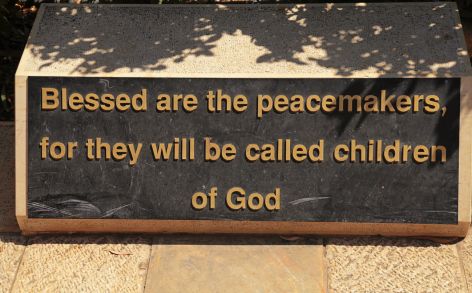
<p>“Blessed are the peacemakers” (Matthew 5:9).</p>

“Blessed are the peacemakers” (Matthew 5:9).

The remainder of the sermon gives more specifics of conversion—how to be a Christian.

How to be a Christian

Jesus Christ taught that His disciples were to be the salt of the earth and the light of the world. They were commanded, “Let your light so shine before men, that they may see your good works and glorify your Father in heaven” (Matthew 5:16). Christians’ examples are to reflect God’s righteousness to the world around them; and by doing so, their actions would shine like lights.

For more on these passages, see “The Salt of the Earth” and “Light of the World.”

Following this admonition is a statement that is vital to understand, but often misunderstood: Christ said that He did not come “to destroy the Law or the Prophets” (verse 17).

In this verse, He emphasized: “I did not come to destroy but to fulfill”—which is the opposite of destroying. Jesus further stated that “whoever does and teaches them [the commandments], he shall be called great in the kingdom of heaven” (verse 19; see “Jesus and the Law”).

Spirit of the law

What follows is a detailed explanation of the spiritual understanding and application of the 10 Commandments. For example, Jesus instructed the audience that it was a spiritual violation of the law against murder to be angry with a person without a cause (verse 22). He also said that men are to avoid adultery, even to the extent of avoiding lusting after women in their hearts (verse 28).

Just imagine a world in which these two admonitions were obeyed—in the letter and the spirit of the law! There would be no road rage or violent verbal abuse. People would try to solve their differences peacefully, and the focus would be on reconciliation. Marriages would be saved, families would thrive and every type of pornography would cease to exist.

Then Jesus Christ gave some of the most difficult instructions to follow: “Love your enemies” and “be perfect, just as your Father in heaven is perfect” (verses 44, 48).

God loves all peoples. He has deep concern even for those who take His name in vain and reject His very existence. That same level of love He has for all humanity is a love that He wants each person to exhibit toward others.

Further instruction from the Sermon on the Mount: Prayer and priorities

Within this sermon is a detailed explanation of how to pray. In Matthew 6 Jesus said that converted Christians are not to “be like the hypocrites. For they love to pray standing in the synagogues and on the corners of the streets, that they may be seen by men” (Matthew 6:5). Rather, He told us to “go into your room, and when you have shut your door, pray to your Father who is in the secret place” (verse 6; see “Private Worship Toward God”).

Also, when we pray, we are not to use “vain repetitions” (verse 7). We are not to just repeat the same words over and over.

Jesus then gave an outline of how we should pray (verses 9-13), praising God in heaven and asking that His Kingdom would come to this earth. We need to ask God for our daily bread (needs), and especially ask Him for forgiveness. After this, Jesus admonished everyone to forgive others their sins and offenses, so our Heavenly Father will forgive us (verses 14-15).

Jesus Christ also discussed the topic of wealth. Where is our treasure? Which master do we serve? “You cannot serve God and mammon [riches]” (verse 24; see “Hidden Treasure”). Therefore we are not to worry about things in this life, what we will eat or drink or what we will wear. Our Heavenly Father already knows our needs. Jesus also stated that God takes care of the needs of the birds, and He is certainly able to take care of our needs as well (verses 25-32).

Jesus then clearly showed us what our top priority should be in life: “Seek first the kingdom of God and His righteousness, and all these things shall be added to you” (verse 33).

The words of this sermon are as relevant today as they were when Christ spoke them!We are instructed further to ask God for help. As parents know how to give good gifts to their children, so, too, will our Father who is in heaven give good things to those who ask Him (Matthew 7:7-11). This is most encouraging!

More Sermon on the Mount teachings: Choices and warnings

As Jesus Christ concluded the Sermon on the Mount in Matthew 7, He admonished us to make proper choices. We are taught to make choices based on God’s instructions in the Bible and not simply follow the crowd by taking the easy way to live (Matthew 7:13-14; see “What Is the Narrow Gate Jesus Talked About?”).

We are even warned about false prophets who claim to be Christian, but whose lives don’t reflect God’s values and true conversion. Prophets and ministers are to be evaluated by their fruits—their actions and the results of those actions (verses 15-20; see “By Their Fruits”).

Then Jesus gave a very serious warning: “Not everyone who says to Me, ‘Lord, Lord,” shall enter the kingdom of heaven, but he who does the will of My Father in heaven” (verse 21). Not everyone who claims to be a Christian is one.

We must obey God’s instructions in the Bible, otherwise God will say, “I never knew you; depart from Me, you who practice lawlessness!” (verse 23).

Why is the Sermon on the Mount so important?

William Barclay summarized many views of the importance of the Sermon on the Mount:

“One great scholar called the Sermon on the Mount ‘The Ordination Address to the Twelve.’ Just as a young minister has his task set out before him, when he is called to his first charge, so the Twelve received from Jesus their ordination address before they went out to their task. It is for that reason that other scholars have given other titles to the Sermon on the Mount. It has been called ‘The Compendium of Christ’s Doctrine,’ ‘The Magna Charta of the Kingdom,’ ‘The Manifesto of the King.’ All are agreed that in the Sermon on the Mount we have the essence of the teaching of Jesus to the inner circle of his chosen men” (William Barclay’s Daily Study Bible, notes on Matthew 5).

But it was not just for the 12 disciples or the audience who first heard the message. God inspired Matthew to record the powerful and memorable words of Jesus’ Sermon on the Mount for Christians throughout the ages and for us today.

Parable of the wise and foolish builders

The words of this sermon are as relevant today as they were when Jesus Christ spoke them!

For “whoever hears these sayings of Mine, and does them, I will liken him to a wise man who built his house on the rock: and the rain descended, the floods came, and the winds blew and beat on that house, and it did not fall, for it was founded on the rock” (Matthew 7:24-25; see “Build on the Rock”).

The foolish builder “who hears these sayings of Mine, and does not do them” is just building on sand, and the results will be catastrophic (verses 26-27).

The question is, will we be like the wise man? Will we take these words to heart from Jesus’ Sermon on the Mount?

Be sure to explore the 22 related articles on the Sermon on the Mount and Christian conversion, where you will find more instruction that will both encourage and help you to be like that wise man!


What Does It Mean to Be Born Again?


Jesus told Nicodemus that he needed to be born again to be in the Kingdom of God. What happens when we are born again? What does it mean to be a child of God?

The third chapter of John’s Gospel includes some very important teachings. Most people have heard of the 16th verse (“For God so loved the world . . .”). The context of this famous verse is the fascinating story of a Pharisee named Nicodemus, who visited Jesus by night.

Who was Nicodemus?

Nicodemus was a Pharisee and “a ruler of the Jews” (John 3:1), which means he was a Jewish leader and probably a member of the Jewish council, the Sanhedrin. Nicodemus would have understood the Old Testament and Jewish tradition very well.

Jesus wasn’t well-liked by the Pharisees in general. But there were exceptions, as Nicodemus acknowledged, “We know that You are a teacher come from God; for no one can do these signs that You do unless God is with him” (verse 2). That was not a popular belief among Pharisees, and it could be why Nicodemus came to visit Jesus at night instead of during the day.

“Unless one is born again”

Jesus then answered Nicodemus with an unexpected statement: “Most assuredly, I say to you, unless one is born again, he cannot see the kingdom of God” (verse 3).

Nicodemus then asked a simple question, “How can a man be born when he is old? Can he enter a second time into his mother’s womb and be born?” (verse 4).

Jesus again replied, “Most assuredly, I say to you, unless one is born of water and the Spirit, he cannot enter the kingdom of God” (verse 5).

Nicodemus seemed baffled by Jesus’ words (verse 9). In fact, it’s been about 2,000 years since Jesus spoke these words, and they still baffle people! What exactly did Jesus mean? What does being born again have to do with seeing and entering the Kingdom of God?

This analogy is very important, because becoming a part of the Kingdom of God is the purpose of human life! Jesus even told us to “seek first” the Kingdom (Matthew 6:33).

Throughout the Gospels, Jesus taught that in the future, He would come again and form a government that will rule the entire world! But His Kingdom was not yet (John 18:36). Christ will come to “sit on the throne of His glory” and rule over “all the nations” (Matthew 25:31-32). The blessed ones, meaning the saints, will “inherit the kingdom” (verse 34).

Nicodemus, like many of his time, misunderstood the plan of God. They imagined that the Messiah would come as a conquering hero to release His physical kinsmen from subjugation to the Roman Empire. Correcting Nicodemus’ misunderstanding, Jesus told him that people must be born again even to see or enter the Kingdom of God.

What does it mean to be born of water and of the Spirit?

“Water” refers to baptism, after which we come up out of a watery grave to live in the newness of life. “Or do you not know that as many of us as were baptized into Christ Jesus were baptized into His death? Therefore we were buried with Him through baptism into death, that just as Christ was raised from the dead by the glory of the Father, even so we also should walk in newness of life” (Romans 6:3-4).

In a secondary sense, water also refers to God’s Word, which washes us spiritually as we apply it through the help of the Holy Spirit (Ephesians 5:26). So, we must first be baptized and then receive God’s Holy Spirit through the laying on of hands (2 Timothy 1:6).

What it means to be born again

Jesus went on to define what it means to be “born again” in the ultimate sense: “That which is born of the flesh is flesh, and that which is born of the Spirit is spirit” (John 3:6).

Paul identifies when this birth will occur—“at the last trumpet,” when Jesus Christ returns to earth.The word born in John 3 is translated from the Greek word gennao. It is difficult to find a one-word English definition of gennao. Spiros Zodhiates, a well-known Greek scholar, in his volume The Complete Word Study New Testament, provides the following definition of gennao: “to beget, pass[ive] voice, to be born, mainly used of men begetting children . . . more rarely of women begetting children . . . deliver . . . of conception (Matthew 1:20).” He also states this word is used metaphorically of God’s divine nature imparted to the believer (John 3:357).

Bauer-Arndt-Gingrich’s A Greek-English Lexicon of the New Testament and Other Early Christian Literature adds the figurative definition “bring forth, produce, cause.” Thayer’s Greek Lexicon also mentions it can refer more rarely to women giving birth to children. According to Merriam-Webster.com, “beget” means “to procreate as the father, sire.” Perhaps “sire” or “father” (verb) is as close as one can come to a one-word definition of gennao.

When we are born into this world, we are born into a physical life with a physical family. We are made of flesh and are mortal. But when we enter the Kingdom of God, we will be “born of the Spirit”—meaning we will be transformed into spirit. We will no longer be physical, imperfect beings. Instead, we will be spirit beings!

Jesus went on to use an analogy to describe what spirit life is like: “The wind blows where it wishes, and you hear the sound of it, but cannot tell where it comes from and where it goes. So is everyone who is born of the Spirit” (verse 8).

Many years later Paul wrote more details about what it means to be “born of the spirit” into the Kingdom of God:

“And as we have borne the image of the man of dust [or as Jesus said, been ‘born of the flesh’], we shall also bear the image of the heavenly Man [or as Jesus said, be ‘born of the Spirit’]. Now this I say, brethren, that flesh and blood cannot inherit the kingdom of God; nor does corruption inherit incorruption. Behold, I tell you a mystery: We shall not all sleep, but we shall all be changed—in a moment, in the twinkling of an eye, at the last trumpet. For the trumpet will sound, and the dead will be raised incorruptible, and we shall be changed. For this corruptible must put on incorruption, and this mortal must put on immortality” (1 Corinthians 15:49-53).

Paul identifies when this birth will occur—“at the last trumpet,” when Jesus Christ returns to earth (Matthew 24:311 Thessalonians 4:16).

This rebirth, the change from flesh and blood to spirit, is necessary to enter the Kingdom of God. Flesh-and-blood human beings cannot inherit the Kingdom of God. Only those who are “born of the Spirit”—those who are resurrected to incorruptible and immortal life at Christ’s return—can be in the Kingdom of God.

To learn more about the purpose of human life, read “Why Were You Born?

Jesus is the firstborn

Jesus Christ has already been born into the Kingdom of God. Notice these two scriptures:

  • “For whom He foreknew, He also predestined to be conformed to the image of His Son, that He might be the firstborn among many brethren” (Romans 8:29, emphasis added throughout).
  • “And from Jesus Christ, the faithful witness, the firstborn from the dead, and the ruler over the kings of the earth” (Revelation 1:5).

These verses reveal two important truths: First, Jesus is the first of many other brethren (brothers and sisters) who will be born into God’s Kingdom. Second, Jesus was born from the dead. His birth took place when He was resurrected from the dead.

Jesus was “declared to be the Son of God with power according to the Spirit of holiness, by the resurrection from the dead” (Romans 1:4). He was transformed from flesh to spirit and reunited with His Father.

The use of the term firstborn shows that many others will ultimately be born into that same family. God the Father is calling men and women today to be “sons and daughters” in His family (2 Corinthians 6:18). Those He is calling will be God’s children in the fullest sense when they are resurrected and glorified by being transformed into spirit. They will then be “like” Jesus Christ (1 John 3:2).

What does it mean to be a child of God?

Though the Bible shows that our ultimate birth into God’s Kingdom won’t take place until we are transformed from flesh to spirit at Christ’s return, the Bible is also clear that, in another sense, we are God’s children now.

There are many scriptures that refer to God’s people as His children in this life:

  • “The Spirit Himself bears witness with our spirit that we are children of God” (Romans 8:16).
  • “That you may become blameless and harmless, children of God without fault in the midst of a crooked and perverse generation, among whom you shine as lights in the world” (Philippians 2:15).
  • “Behold what manner of love the Father has bestowed on us, that we should be called children of God!” (1 John 3:1).
  • “Beloved, now we are children of God; and it has not yet been revealed what we shall be, but we know that when He is revealed, we shall be like Him, for we shall see Him as He is” (1 John 3:2).
  • “Whoever has been born of God does not sin, for His seed remains in him; and he cannot sin, because he has been born of God” (1 John 3:9). This verse is talking about practicing sin or habitual sin, as opposed to practicing righteousness (verse 10; see also 1 John 1:8-10).
  • “By this we know that we love the children of God, when we love God and keep His commandments” (1 John 5:2).

The Bible is clear that being a child of God is both a present and a future reality for God’s people who have His Holy Spirit.

We are God’s children today because when we are baptized, we receive God’s Spirit. God’s Spirit begets us as children of God (1 Peter 1:31 John 5:1). That means that God becomes our spiritual Father, and we begin the process of growing in a Father-child relationship with Him and developing His character.

Being born again—entering the Kingdom of God by a resurrection to glory—is the whole purpose of being a Christian (Philippians 3:8-14).Through baptism and the laying on of hands, we enter God’s family in this sense. God becomes our Father; Jesus Christ, our Elder Brother; and other Christians, our brothers and sisters. Just as children grow and develop physically, we are to grow spiritually by seeking the pure milk of God’s Word (1 Peter 1:22-252:1-3).

We can learn many lessons about spiritual growth from the growth of children. For instance, we can learn about spiritual development from the development of a fetus in the womb of his or her mother. Just as a fetus grows and develops in the womb, we are to grow and develop spiritually. Just as a fetus relies on the nourishment of its mother, we are to rely on the nourishment of God’s Word. Just as loving parents will consider that developing fetus to be their son or daughter and a member of their family, God considers us to be His children.

We can also learn many lessons from the development of children after birth. As children grow in strength, stature, knowledge and maturity, so Christians must be growing in spiritual strength, stature, knowledge and maturity. Just as young children depend on their parents, so we must depend on God.

Just as children are humble and trusting, so we are to humbly trust God. Just as young children rely on their father and mother for protection and safety, Christians rely on the Father for spiritual protection and on God’s Church for a spiritually safe environment to grow and develop Christian character.

Both analogies can teach us much about Christian growth.

But we won’t be God’s children in the fullest sense until we are “born of the Spirit” at the resurrection of the dead. At that point, we will be spirit. We will also become perfect and immortal as God is. Just as children are the same kind of being as their parents (human beings), so we will be the same kind of beings as God our Father and Jesus Christ (divine beings). We will share in God’s glory.

This is the fullest sense of what it means to be born again and become a child of God.

To learn more about being a child of God, read “Are We Children of God Now?

The process of Christian conversion

But in order for this process to occur, we must be converted. The conversion process is not just a shallow emotional decision. It requires that a person repent of his or her sins, be baptized in water, receive the indwelling presence of the Holy Spirit of God, grow in the grace and knowledge of God and be guided by His righteous law. At the end of this process, in the resurrection, the person is finally changed into an immortal spirit being, thereby entering the Kingdom of God!

The apostle Paul said that his whole life—growing and enduring the challenges of the Christian life—was directed toward this supreme goal. Being born again—entering the Kingdom of God by a resurrection to glory—is the whole purpose of being a Christian (Philippians 3:8-14).

That’s what it means to be born again!


Do Not Quench the Spirit


The apostle Paul admonished members of the church at Thessalonica, “Do not quench the Spirit.” What does this warning mean for us today?

It is a sobering exhortation—a caution to avoid spiritual suicide.

At the end of his first letter to the fledgling church at Thessalonica, Paul instructed the members to “quench not the Spirit” (1 Thessalonians 5:19, King James Version).

What did Paul mean by this stark directive? And how can Christians today make sure they “do not quench the Spirit”?

A turbulent beginning

It’s helpful to know something of the environment in which Paul had established the church at Thessalonica. This had a direct bearing on his motivation for issuing the warning not to “quench the Spirit.”

Paul had begun in Thessalonica, as he had in so many other places, by first teaching in the city’s synagogue (Acts 17:2). The reaction of the local Jews was mixed. “Some of them were persuaded” (verse 4), but many were not.

Those who were not persuaded began aggressively seeking to discredit the apostle and his companions. Their actions created a riot (verse 5).

The turmoil was so great, and the danger for Paul and Silas so evident, that the members—all newly converted—sent the two away by night. After all, these new members in Thessalonica knew that Paul and Silas had been beaten and imprisoned in Philippi (Acts 16:19-24; 1 Thessalonians 2:2).

A hard place to grow in faith

The antagonism of these Thessalonian Jews was truly intense. Their hostility was directed not only toward Paul and Silas, but also toward the new members.

Even while Paul and Silas were still in the city, the mob of “evil men” (Acts 17:5) incited by the unpersuaded Jews “attacked the house of Jason.” It was in the shadow of this ongoing danger that members of the newly formed congregation began their Christian journey.

So Paul noted they had “received the word in much affliction” (1 Thessalonians 1:6). Though absent from them, “the apostle was deeply concerned about the state of the recently founded church in Thessalonica” (The Zondervan Pictorial Encyclopedia of the Bible, Vol. 5, p. 722).

Praise and encouragement from Paul

We see Paul’s concern, as well as affection, in 1 Thessalonians. Paul wrote this epistle after Timothy had returned with “good news” of their “faith and love” (1 Thessalonians 3:6).

Christians who do not continue to draw on the power of the Holy Spirit, who do not remain committed to God’s way of life, may find that God withdraws this precious gift.In this letter, the apostle lavished praise and encouragement on the members. He wrote of their “work of faith” and “labor of love” (1 Thessalonians 1:3). He pointed out that they had become “examples to all in Macedonia and Achaia” (verse 7).

The apostle also commended members of the congregation for their openness to his preaching. These men and women had, in Paul’s words, “welcomed it not as the word of men, but as it is in truth, the word of God” (1 Thessalonians 2:13).

Paul’s tone in the first half of this epistle reflects his pastoral love and concern as well as his desire to build up and encourage the congregation in its struggles.

“Quench not the Spirit” in context

It is in 1 Thessalonians 4 that Paul moves from praise and encouragement to instruction and admonition. He reminded the congregation that they were being set apart (sanctified) by God to live holy lives (verses 3-7).

In the final chapter, Paul’s tone becomes even more solemn. He begins with a warning that “the day of the Lord so comes as a thief in the night” (1 Thessalonians 5:2). He did not want anyone he had taught to become complacent and, as a result, to set aside commitment to God’s way of life.

It is in this context that Paul wrote a number of exhortations.

  • He urged the Thessalonians to respect “those who labor among you” (verse 12), referring to the ministry.
  • He encouraged them to “be at peace among yourselves” (verse 13).
  • He also pressed them to “pray without ceasing” (verse 17) and to continue to regularly thank God for His blessings (verse 18).
  • Paul then wrote his sobering warning not to “quench the Spirit” (verse 19).

Clearly, quenching the Spirit is associated with attitude and conduct.

The same warning in the parable of the 10 virgins

The Greek word translated “quench” in 1 Thessalonians also appears in the parable of the 10 virgins (Matthew 25:1-13). There it is translated “going out.” In the parable, five foolish virgins discover that their “lamps are going out” (Matthew 25:8).

What makes this parable so significant for our understanding is that it is a warning about the Holy Spirit itself, which is represented by the oil. And that warning is given in the context of the return of Christ, represented by the Bridegroom.

Finding Hope in a Hopeless World Booklet

Both of these elements are also present in 1 Thessalonians 5. So when Paul wrote about quenching the Spirit, it was in the same context as the parable of the 10 virgins.

This parable differs because the virgins are guilty of neglect rather than any deliberate act. In both cases, however, the result is the same. The “fire” of the Holy Spirit goes out.

The end of the parable is just as grave as Paul’s words in 1 Thessalonians. The foolish virgins find themselves barred from the wedding, with the Bridegroom telling them, “I do not know you” (Matthew 25:12).

For more about this, see “Lessons From the Parable of the 10 Virgins.”

What Paul’s warning means for us

The discussion of the prophetic Day of the Lord remains significant for us today. Throughout Scripture, this time is portrayed as being filled with evil and danger. Paul himself describes this end-time period as “perilous times” (2 Timothy 3:1).

The dangers and troubles the young Thessalonian congregation had already experienced were just a forerunner to what Paul expected the whole Church to experience before the end. He knew that to remain faithful under such conditions would be difficult, and “all who desire to live godly in Christ Jesus will suffer persecution” (verse 12).

There is always the temptation for persecuted Christians to compromise their commitment “to live godly in Christ.” But we, too, must strive to live pure and holy lives (1 Thessalonians 4:3-7). We must not reject “God, who has also given us His Holy Spirit” (verse 8).

Rejecting God results in quenching His Spirit

It is this rejection of God that results in the quenching of His Spirit. Christians who do not continue to draw on the power of the Holy Spirit, who do not remain committed to God’s way of life, may find that God withdraws this precious gift.

This is a frightening possibility described in the book of Hebrews:

Is the Sermon on the Mount relevant to me?

“For it is impossible for those who were once enlightened, and have tasted the heavenly gift, and have become partakers of the Holy Spirit, and have tasted the good word of God and the powers of the age to come, if they fall away, to renew them again to repentance, since they crucify again for themselves the Son of God, and put Him to an open shame” (Hebrews 6:4-6).

This idea may seem foreign to some readers. After all, one popular idea among professing Christians is that once they have accepted Jesus as their personal Savior, their future is eternally secure. This passage from Hebrews, among others, shows that idea is not biblically accurate.

To learn more, read our article “Once Saved, Always Saved?

What can a Christian do to avoid quenching the Spirit?

When everyone depended on fire for lighting, cooking and heating, people learned how to keep literal flames from going out. In a similar way, Christians need to follow Paul’s advice to Timothy to “stir up the gift of God which is in you through the laying on of my hands. For God has not given us a spirit of fear, but of power and of love and of a sound mind” (2 Timothy 1:6-7).

To learn more about stirring up God’s Spirit, read our blog post “The Meaning of 2 Timothy 1:6: Stir Up the Gift of God.”

This means Christians must align their lives with God’s will and purpose and with His laws and instructions. It means continually repenting of the “works of the flesh” (Galatians 5:19-21) and working to cultivate the “fruit of the Spirit” (verses 22-23; see our Journey “The Fruit of the Spirit”).

So, how can you avoid quenching the Spirit? Here are a few pointers:

  • Be like the 3,000 individuals who “were cut to the heart” at Peter’s preaching and repented, were baptized and received the Holy Spirit (Acts 2:37-41). Then follow the lead of God’s Holy Spirit within you. Learn more in our article “How Do You Know You Have the Holy Spirit?
  • Listen to and respect your Bible-believing teachers in the faith (1 Thessalonians 5:12), but at the same time, be sure to “test all things; hold fast what is good” (verse 21). You don’t want to follow a false teacher away from God, just as you don’t want to turn from faithful ministers who “watch out for your souls” (Hebrews 13:17).
  • Take the Bible seriously! It is the Word of God, and God pays attention to the person “who is poor and of a contrite spirit, and who trembles at My word” (Isaiah 66:2).
  • Stay close to God through prayer. As Paul exhorted the Thessalonians, “pray without ceasing” (1 Thessalonians 5:17).
  • Continue to be engaged and committed to the mission God gave His Church—to preach the gospel to all nations (Matthew 24:14; 28:19-20). Those who have their hearts in this effort grow spiritually.
  • Be mentally prepared to deal with obstacles to your faith. As noted above, “all who desire to live godly in Christ Jesus will suffer persecution” (2 Timothy 3:12). If you are a Christian, there will be times when your faith is tested. Resolve in your mind now to remain committed to God’s way of life.

A Believers Body As A Temple

  1 Corinthians 3:16-17 Do you not know that you are a temple of God and that the Spirit of God dwells in you? If any man destroys the templ...