Thursday, June 12, 2025

Messiah’s Message: Gospel of the Kingdom


What was Jesus the Messiah’s message, and what were His main themes? This article begins a five-part series and focuses on the gospel of the Kingdom.

As the New Testament opened about 2,000 years ago, the Jewish people were looking for the appearance of the prophesied Messiah—a Hebrew word meaning “anointed” (Matthew 11:3Luke 3:15). Because of Moses’ teaching that a prophet like himself would arise (Deuteronomy 18:15), some were looking for a religious leader to appear and lead the nation in a great spiritual revival (Luke 1:68-692:25, 30, 38).

Others were anticipating the Messiah coming as the “Son of David” who would liberate the Jews from Roman rule, elevate the renewed Jewish nation in the eyes of the world, and establish His throne in Jerusalem (Matthew 21:922:42). Believing that Jesus was this person, some plotted to “take Him by force to make Him king” (John 6:15).

But when Christ—the Greek term for “anointed”—came to earth in the form of a human named Jesus, the majority of the Jewish religious leaders did not accept Him as the promised Messiah. To them, Jesus was a young upstart who was critical of their handling of authority and who hadn’t shown any potential to liberate the Jewish people or establish a throne. 

Key points of Jesus’ message: the gospel of the Kingdom of God

Jesus began “preaching the gospel [good news] of the kingdom of God,” but it was not what the Jewish patriots were expecting (Mark 1:14). Instead of orchestrating a political movement and restoring Israel to greatness, Jesus’ key talking points were: “The time is fulfilled, and the kingdom of God is at hand. Repent, and believe in the gospel” (verse 15).

Error NaN

Watch this three-minute video summary of Jesus’ message, presented by Dave Myers, Foundation Institute instructor.

Of course, there were some who believed what Jesus said. John the Baptist’s call to repent (change their behavior) had been heard by many, preparing the way for Christ’s message. The New Testament and secular history concur that His message did indeed take root. The Church of God was established and strove to fulfill His commission (Matthew 28:19-20).

History shows that Christianity was a force that defied fierce persecution and the sword. Yet within decades following Jesus’ crucifixion, false teachers who claimed to be Christian began dismantling what He had labored to convey and instill in His disciples. 

Today within mainstream Christianity important aspects of the Messiah’s message have been laid aside. The errors and omissions are not always quickly recognized, for the revisions are commonly presented to be “mature” Christianity as opposed to “primitive” Christianity. 

How sad, preposterous and even arrogant it is to believe that humans needed to improve the message Jesus delivered or that changes needed to be made in order for Christ’s Church to blossom and flourish!

Such reasoning is clearly refuted by Jude, the half-brother of Jesus, who heard and accepted Jesus’ teaching as it had been presented. 

The true gospel: part of the faith once delivered

Recognizing the efforts of some to change what Jesus had taught, Jude felt compelled to warn those of the first century and us today to reject these misguided ideas. 

“Beloved, while I was very diligent to write to you concerning our common salvation, I found it necessary to write to you exhorting you to contend earnestly for the faith which was once for all delivered to the saints. For certain men have crept in unnoticed, who long ago were marked out for this condemnation, ungodly men, who turn the grace of our God into lewdness and deny the only Lord God and our Lord Jesus Christ” (Jude 1:3-4, emphasis added).

Jude’s instruction provides historical documentation of the effort of ungodly men to change Christ’s message near the end of the first century.

It also explains that we deny “the only Lord God and our Lord Jesus Christ” when we deny the true gospel of the Kingdom given by God the Father through His Son (Jude 1:4John 17:8).


Even though the apostle Paul was commissioned to take Christianity to the gentiles (non-Jews), he taught the same original, authentic gospel of the Kingdom that Jesus Christ and that the other apostles taught. He instructed the gentiles to be “imitators of the churches of God which are in Judea” (1 Thessalonians 2:14).

And Paul, like Jude, recognized the misguided efforts of evil men to “pervert the gospel of Christ” (Galatians 1:7).

To make plain what Jesus really taught and how He expects people to respond to His message, this article begins a series addressing these critically important concepts. 

Let’s now focus on the gospel of the Kingdom of God that Jesus came preaching. 

Gospel of Christ vs. the gospel of the Kingdom

When we read of Jesus “preaching the gospel of the kingdom of God” (Mark 1:14), we should note that there was something new and something old about this endeavor.

The teaching of a coming Kingdom ruled by God was not new—Old Testament prophets under the inspiration of God had already prophesied this (2 Peter 1:21Isaiah 9:7Daniel 2:447:18, 27). What was new was Jesus Christ personally preaching this message as a flesh-and-blood human. 

Unfortunately, one of the chief ways the Messiah’s message has been distorted has occurred over how the gospel is defined. Some argue over whether it is the “gospel of Jesus Christ” (Mark 1:1) or “the gospel of the kingdom of God” (verse 14).

The simple facts are that Christ was the “Messenger of the covenant” (Malachi 3:1) who spoke the words of God the Father (John 3:3414:1017:18). Jesus was the One who gave His life as the payment for the sins (Ephesians 1:7) of those who truly repent so they can receive the Holy Spirit (Acts 2:38) and become children of God in His eternal Kingdom (John 1:12Luke 12:32). 

In addition to knowing that Christ is Lord, we must also do the will of the Father.

As our Savior and as the King of the coming Kingdom of God (Revelation 11:1519:16), Jesus is central to the message, but the gospel message Jesus came preaching is not limited to Himself.

Just knowing who Jesus is and what He has done will not bring salvation to anyone. If we “accept Jesus into our hearts” (as many put it) but continue living in opposition to God’s laws, we cannot expect to receive the wonderful benefits—including eternal life—that He offers.

In addition to knowing that Christ is Lord, we must also do the will of the Father (Matthew 7:21). 

The true gospel includes Jesus Christ, what He has done and what He expects of us—as well as what will occur when He returns to establish the Kingdom of God on earth. The gospel of the Kingdom of God and the gospel of Christ are the same message. They are not competing gospels! 

The gospel of Christ is the gospel of the Kingdom. 

How the message of a literal kingdom disappeared

Within mainstream Christianity it has become common to focus on the person of the Messiah and what He did, while excluding explanations of the coming Kingdom of God and what we must do to be part of it. 

How did Jesus Christ’s instruction regarding a literal kingdom that would be established to rule over the earth disappear from mainstream Christianity?

English historian Edward Gibbon, in his famous book The History of the Decline and Fall of the Roman Empire, provides the answer. 

Gibbon noted that as part of the “ancient and popular doctrine of the Millennium,” the early Christians believed that they would be resurrected to spirit life to reign upon the earth with Jesus Christ for a thousand years after He returned (Chapter XV: Progress of the Christian Religion Part IV). The author says that this teaching, which had been so helpful to the “progress of the Christian faith,” was gradually laid aside. 

“The doctrine of Christ’s reign upon earth was at first treated as a profound allegory, was considered by degrees as a doubtful and useless opinion, and was at length rejected as the absurd invention of heresy and fanaticism” (ibid.).

The next article in this series will address the first key element of the Messiah’s message—“the time is at hand” (Mark 1:15). For further study of this subject, we invite you to download the free booklet The Mystery of the Kingdom. We also recommend our article on the Millennium and the articles in the section “The Kingdom of God.”


Born to Be a King


Most have heard that Jesus Christ was born to be our Savior. But how many really think about the fact He was born to be a king—and He wants us to be kings too?

Have you ever wondered why the wise men presented Jesus with gold, frankincense and myrrh? These precious gifts were typical of what would be presented to a king—just as the queen of Sheba presented gold and spices to King Solomon (1 Kings 10:10).

And have you ever wondered why the magi asked King Herod, “Where is He who has been born King of the Jews?” (Matthew 2:2). They obviously took the prophecies of the Christ as the anointed King literally. And so did Herod, who then tried to kill any possible competitor for the throne.

Matthew clearly shows that Jesus was of the royal lineage of Israel’s most famous king, David. And Jesus Himself plainly stated to the Roman governor Pilate, “You say rightly that I am a king. For this cause I was born, and for this cause I have come into the world, that I should bear witness to the truth” (John 18:37).

The angel’s message to Mary, the mother of the King

Before Jesus’ birth, the angel Gabriel brought an important message to Mary: “And behold, you will conceive in your womb and bring forth a Son, and shall call His name JESUS. He will be great, and will be called the Son of the Highest; and the Lord God will give Him the throne of His father David. And He will reign over the house of Jacob forever, and of His kingdom there will be no end” (Luke1:31-33).

This everlasting Kingdom was foretold in many Old Testament passages, such as in Daniel: “And in the days of these kings the God of heaven will set up a kingdom which shall never be destroyed; and the kingdom shall not be left to other people; it shall break in pieces and consume all these kingdoms, and it shall stand forever” (Daniel 2:44; read more in our article “What Is the Kingdom of God?”).

As the Son of the Highest, Jesus would die and become the Savior of all mankind. The name Jesus is from the Greek form of Joshua, which means “savior” in Hebrew. The title Christ is the equivalent of the Hebrew term Messiah, which means “anointed.” 

The biblical tradition was for kings to be anointed as David was (1 Samuel 16:12-13). As shown in Matthew 1, Jesus Christ is a direct descendant of David. As Messiah (the anointed One), He will inherit David’s throne, and He will also become the King of Kings over the whole world. He is ready to take up His position when the time is right. 

Naturally, His disciples wondered when Jesus would take over as King. They asked the risen Christ, “Lord, will You at this time restore the kingdom to Israel?” (Acts 1:6).

When will Jesus Christ bring the Kingdom of God?

In the minds of the apostles, the messianic King would soon bring freedom from Roman oppression and usher in the peace and prosperity pictured by prophecies they had heard since childhood. 

But Jesus knew there was much to be done in preparation for His return when He comes as a conquering leader for the benefit of all mankind. He told His disciples that only the Father knew when the time would be right. Until then, His people are to be involved in a special work right up until the end of the age:

“And He said to them, ‘It is not for you to know times or seasons which the Father has put in His own authority. But you shall receive power when the Holy Spirit has come upon you; and you shall be witnesses to Me in Jerusalem, and in all Judea and Samaria, and to the end of the earth’” (Acts 1:7-8; see also Matthew 24:36). 

God’s Church is to teach the gospel (good news) of the coming King, His Kingdom and His laws to all who will become His subjects.God’s Church is to teach the gospel (good news) of the coming King, His Kingdom and His laws to all who will become His subjects (Matthew 24:1428:18-20).

But when will He take over as King? Jesus told Pilate, “My kingdom is not of this world. If My kingdom were of this world, My servants would fight, so that I should not be delivered to the Jews; but now My kingdom is not from here” (John 18:36).

A Kingdom not of this world

What did Jesus mean when He said that His “kingdom is not of this world”? 

This society—this world—has been conditioned over thousands of years to the way of getting rather than giving. We often respond to life with self-concern instead of obedience to God and caring for others as much as ourselves. The apostle John said, “For all that is in the world—the lust of the flesh, the lust of the eyes, and the pride of life—is not of the Father but is of the world. And the world is passing away, and the lust of it; but he who does the will of God abides forever” (1 John 2:16-17).

A different kind of King

God’s way is the way of giving. Jesus’ rule will always be for the benefit and development of humanity.

This is not the way that most national rulers behave in the world. As Christ told His disciples, “You know that the rulers of the Gentiles [nations] lord it over them, and those who are great exercise authority over them. Yet it shall not be so among you; but whoever desires to become great among you, let him be your servant. And whoever desires to be first among you, let him be your slave—just as the Son of Man did not come to be served, but to serve, and to give His life a ransom for many” (Matthew 20:25-28).

That devotion to serve mankind will be the hallmark of the reign of the King of Kings. We read that He will “judge between the nations,” and the result will be the beating of swords into plowshares, bringing peace and understanding between longtime national enemies (Isaiah 2:4Micah 4:3).

Taking over as King of Kings

The Bible describes the awesome time when Jesus Christ will take over the kingdoms of the earth at His second coming.

“Then the seventh angel sounded: And there were loud voices in heaven, saying, ‘The kingdoms of this world have become the kingdoms of our Lord and of His Christ, and He shall reign forever and ever!’ And the twenty-four elders who sat before God on their thrones fell on their faces and worshiped God, saying: ‘We give You thanks, O Lord God Almighty, the One who is and who was and who is to come, because You have taken Your great power and reigned’” (Revelation 11:15-17).

Jesus Christ will carry the title: “KING OF KINGS AND LORD OF LORDS” (Revelation 19:16; read more in our article “King of Kings and Lord of Lords”).

But who are the kings Christ will be “King of Kings” over? The Bible shows that the human, selfish leaders of this age will be replaced in the age to come by caring rulers, converted from selfishness to concern and changed to spirit by the resurrection at Christ’s return (Revelation 5:101 Thessalonians 4:16-17).

Christians called to be kings

That devotion to serve mankind will be the hallmark of the reign of the King of Kings.The apostle John described Jesus Christ’s role as both our Savior and King and showed how He is preparing us now for our future roles assisting Him:

“To Him who loved us and washed us from our sins in His own blood, and has made us kings and priests to His God and Father, to Him be glory and dominion forever and ever” (Revelation 1:5-6; see also 20:4).

Jesus also discussed the future jobs of His followers several times in the Gospels. At one point in their training, the disciples asked Jesus, “See, we have left all and followed You. Therefore what shall we have?” (Matthew 19:27). In other words, is this really worth the effort?

Jesus encouraged them: “Assuredly I say to you, that in the regeneration, when the Son of Man sits on the throne of His glory, you who have followed Me will also sit on twelve thrones, judging the twelve tribes of Israel. And everyone who has left houses or brothers or sisters or father or mother or wife or children or lands, for My name’s sake, shall receive a hundredfold, and inherit eternal life” (verses 28-29).

One of Jesus Christ’s parables described some of His followers being given “authority over ten cities,” some over five and so on. This shows that those who use the responsibilities given to them for the profit of the Kingdom will be better able to serve mankind as rulers under Christ (Luke 19:11-27; Matthew 25:13-30).

So how do we train for such awesome responsibilities?

Training to be kings and priests

Jesus is already King over all repentant and converted Christians, and He is preparing His followers for responsibilities in the Kingdom of God. As the apostle John recorded, “For You were slain, and have redeemed us to God by Your blood out of every tribe and tongue and people and nation, and have made us kings and priests to our God; and we shall reign on the earth” (Revelation 5:9-10).


How are kings trained? Consider the example of future kings or queens in nations where there is a constitutional monarchy today. They are taught to handle responsibility and the affairs of state from an early age.

For example, Prince George, third in line to the British throne, at the age of 1 (at the time of this writing) had already become a loved representative of the British monarchy, and he will have a rigorous training program ahead. And, of course, his parents, William and Kate, duke and duchess of Cambridge, endure intense scrutiny as they perform duties on behalf of Queen Elizabeth.

When people see attitudes of service and love in spite of stressful circumstances, it can endear their monarchs to them.

Our training to be kings in an everlasting Kingdom must be even more rigorous. But this can also include small matters we may consider insignificant.

Jesus is looking for faithfulness in all things and will commend those who succeed in His training program: “Well done, good and faithful servant; you have been faithful over a few things, I will make you ruler over many things. Enter into the joy of your lord” (Matthew 25:23, emphasis added throughout).

We don’t have to have many possessions to show God’s nature in our lives. Jesus said of the generous widow who had very little, “Truly I say to you that this poor widow has put in more than all; for all these out of their abundance have put in offerings for God, but she out of her poverty put in all the livelihood that she had” (Luke 21:3-4).

This trust that God would provide for her needs is part of the trust we need to have in our Father’s loving care, in good and bad times.

Our training for the Kingdom of God

Our training needs to include:

  • Learning and obeying the laws of the Kingdom. These are the laws of God in the Bible and are expanded by Jesus Christ to show their spiritual intent (see Matthew 5:17-48). Download our booklet God’s 10 Commandments: Still Relevant Today for more details.
  • Thinking and acting the way the King of Kings thinks and acts. This involves repentance from the selfish ways we used to follow and allowing the Spirit of God to dwell in us. Our booklet Change Your Life! can help you begin this process.
  • Developing the character of the King. Jesus Christ was willing to give His life for humanity. We are told we must put away sin and follow Him: 

“Let us lay aside every weight, and the sin which so easily ensnares us, and let us run with endurance the race that is set before us, looking unto Jesus, the author and finisher of our faith, who for the joy that was set before Him endured the cross, despising the shame, and has sat down at the right hand of the throne of God” (Hebrews 12:1-2).

The wonderful coming Kingdom of God

When Jesus returns He will establish the millennial Kingdom of God, bringing all that man has always wanted—peace, security, a meaningful life, happy families and a relationship with God, who is waiting to welcome us into eternity. 

Then the prophecy about this great King, and the kings who serve Him, will be fulfilled: “And He who sits on the throne will dwell among them. They shall neither hunger anymore nor thirst anymore; the sun shall not strike them, nor any heat; for the Lamb who is in the midst of the throne will shepherd them and lead them to living fountains of waters. And God will wipe away every tear from their eyes” (Revelation 7:15-17).

Jesus Christ was born to be Savior and King for the good of all mankind, and indeed all creation! Download our free booklet The Mystery of the Kingdom to understand more about this inspiring but often-misunderstood truth of the Bible.


What Was Jesus’ Message?


The four Gospels are very clear that Jesus’ primary message was about the Kingdom of God. Yet why is it so hard to find Jesus’ message in today’s Christianity?

The myriad of churches that make up Christianity profess that their religion is based on Jesus Christ. Nearly all claim Him as their founder and say that their teachings are based on what He said and did 2,000 years ago. But, sadly, there are many doctrines where mainstream Christianity ignores or actually rejects the teachings of Jesus Christ.

One major example of Christianity ignoring something Jesus plainly taught is His central message.

Here is a bold assertion: Mainstream Christianity almost entirely ignores the core message Jesus Christ brought when He walked the earth 2,000 years ago. But what was Jesus’ message?

His core message was the Kingdom of God.  

He pinpointed this central message in the heart of His most famous sermon—the Sermon on the Mount. He made a statement about what should be the highest priority for His followers: “But seek first the kingdom of God and His righteousness, and all these things shall be added to you” (Matthew 6:33, emphasis added).


Jesus Christ’s words are clear—the Kingdom of God is to be the No. 1 focus and emphasis in the lives of His followers. In fact, it was the core of His gospel message. Jesus’ gospel message was all about the Kingdom of God coming to this earth.

What is the gospel?

Gospel is a common word in the Christian world. Some think of it in connection with a genre of religious music, but in the Bible the word gospel describes a message. It literally means a message of good news.

Most churches include the word gospel in their mission statements. Typically, the gospel is described as the gospel of Jesus Christ, and it is seen as the message of His life, death and resurrection. (You can see this by doing a Google search of the mission statements of different denominations of Christianity.)

But was this the central message that Jesus actually taught? Was His message only about Himself?

A study of the Gospel accounts of Christ’s life pinpoints exactly what His message—His gospel—was all about!

Notice Mark 1:14: “Now after John was put in prison, Jesus came to Galilee preaching the gospel of the kingdom of God.” That statement is pretty plain—Jesus preached the gospel about the Kingdom of God!

There are many scriptures that reinforce this fact. For example, Matthew 9:35 says, “Then Jesus went about all the cities and villages, teaching in their synagogues, preaching the gospel of the kingdom.”

At one point in His ministry, Jesus was about to leave an area where He had been preaching for some time. The people of that area tried to persuade Him not to go (Luke 4:42). Jesus’ response was, “I must preach the kingdom of God to the other cities also, because for this purpose I have been sent” (verse 43).

Let that sink in.

Jesus Christ said that one of His primary purposes for coming to earth was to preach about the Kingdom of God! That was His gospel. That was His message. That was His purpose. That is what drove and motivated Him.

When we understand the thrust of Jesus’ message about the Kingdom of God, we understand better why He made the statement in Matthew 6:33: “Seek first the kingdom of God.” He tells us to seek first the Kingdom because the Kingdom of God was His primary message.

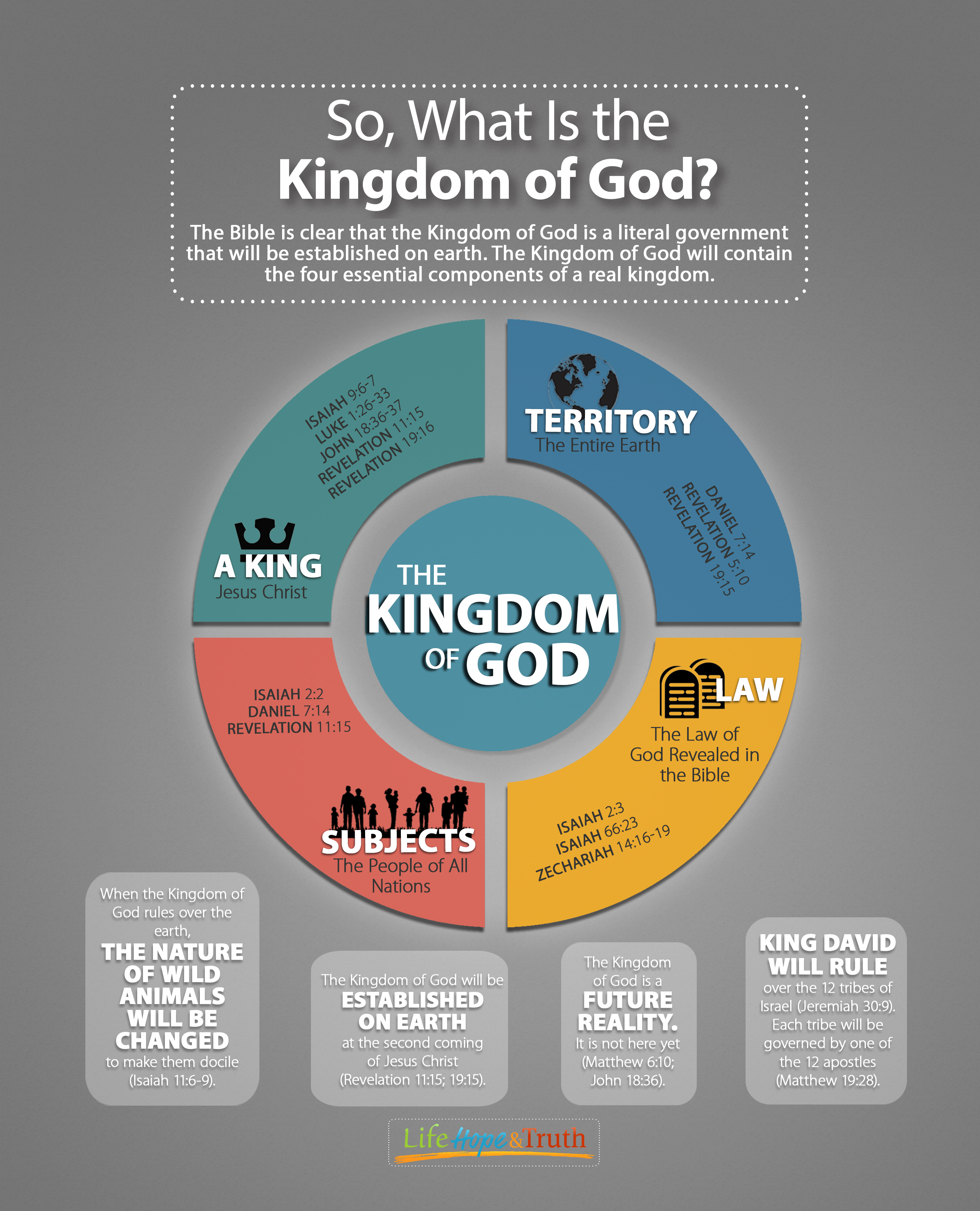
What was Jesus’ message? It was a message about the literal establishment of the Kingdom of God on earth at the second coming of Jesus Christ. See our infographic on this page to learn more details about what the Kingdom of God is.

Christians who seek to follow Jesus Christ’s footsteps should make the Kingdom of God as high a priority in their lives as it was in Christ’s life. Jesus came to set us an example of how to live. He then died for our sins and was resurrected so we can have an opportunity to be in the Kingdom of God.

Everything Jesus did during His earthly ministry ultimate leads to the Kingdom of God. That is why He summarized His message by calling it the gospel of the Kingdom of God.

But where is that message in mainstream Christianity today?

So, What Is the Kingdom of God?

Download infographic PDF

How Christianity lost Jesus’ message

After Christ was resurrected and ascended to heaven, He founded a Church. The purpose of that Church—that called-out group of people—was to carry on the work He did while on earth. Christ commissioned His Church to go into the entire world and preach the same message that He preached while He was on earth (Matthew 24:1428:19-20Mark 16:15Acts 1:3-8).

The Bible shows that the early Church faithfully followed Christ’s directive and preached the gospel of the Kingdom of God (Acts 8:1214:2219:820:2528:23, 31). The members of the early Church also put their focus on the coming Kingdom (Colossians 4:112 Thessalonians 1:5).

Jesus Christ’s words are clear—the Kingdom of God is to be the No. 1 focus and emphasis in the lives of His followers. In fact, it was the core of His gospel message.But as the first century progressed, the intense focus on the Kingdom began to wane as false beliefs began to creep into Christianity. The apostle Paul wrote that he perceived Christians in his time were “turning away” from the true gospel to “a different gospel” (Galatians 1:6).

In what was likely his final letter, Paul gave multiple warnings about his fear that people were abandoning true doctrines and being led astray into false teachings (2 Timothy 2:14-183:13-144:1-3, 14-15).

Other apostles wrote similar warnings (2 Peter 2:12 John 1:7Jude 1:4).

The understanding of the true gospel and the focus on the Kingdom of God were minimized and lost over the centuries after the end of the New Testament era.

A key factor in this was Emperor Constantine’s acceptance of a popular form of Christianity and its subsequent adoption as the official religion of the Roman Empire.

Historian Justo Gonzalez writes: “Since the time of Constantine, and due in part to the work of Eusebius and of many others of similar theological orientation, there was a tendency to set aside or to postpone the hope of the early church, that its Lord would return in the clouds to establish a Kingdom of peace and justice. … Eusebius, although more articulate than most, was simply expressing the common feeling among Christians, for whom the advent of Constantine and of the peace he brought about was the final triumph of Christianity over its enemies” (The Story of Christianity, Vol. 1, pp. 134-135).

This idea was also promoted by the theologian Augustine of Hippo in his highly influential book The City of God: “Therefore the Church even now is the kingdom of Christ, and the kingdom of heaven” (Book XX, Chapter 9).

This belief became known as amillenialism and is a dominant belief (in different forms) in mainstream Christianity today.

Amillenialism is the belief that there is no literal 1,000-year reign of the Kingdom of God on earth, but that Jesus is presently reigning over the earth through the Church. This was one of the major teachings that replaced Jesus’ true gospel throughout large portions of Christianity.

To learn more about what the Bible actually says about the Kingdom of God and the Millennium, read our article “1,000 Years—the Millennium.”

After the true biblical teaching of the Kingdom of God was removed, the gospel message was changed from the message about the Kingdom to a message primarily about Jesus Christ. In other words, Christianity kept the name of Jesus Christ, but abandoned His message.

Jesus was very clear that professing His name but ignoring His teachings is false worship (Luke 6:46). He wants His people to worship Him in “spirit and truth” (John 4:24).

Preaching the true gospel today

The true gospel message of Jesus Christ is not a minor issue. As we have already read, Jesus connected a belief in the true gospel to repentance (Mark 1:15), and the apostle Paul warned that preaching a different gospel brings a curse (Galatians 1:8-9). Believing the true gospel is vital to your salvation!

The true gospel is the message of good news about the coming Kingdom of God. It is a message of hope—for this entire world and for you and your family. It is the message that God is building a family that will soon rule the entire earth, bringing peace and happiness.

The established Christian churches have lost that true gospel message. Discern magazine and the Life, Hope & Truth website exist to continue the proclamation of the true gospel. Even though we are a minority voice in the world of religion, we are dedicated to teaching the same message that Jesus Christ taught.

We try to spread Jesus’ gospel message about the Kingdom of God as far and wide as possible. We want to help as many people as possible adopt Jesus’ message as the central focus of their lives. Seeking first the Kingdom of God can change your life in many ways!

You need to learn more about that true gospel message. We recommend reading our booklet The Mystery of the Kingdom.


A Believers Body As A Temple

  1 Corinthians 3:16-17 Do you not know that you are a temple of God and that the Spirit of God dwells in you? If any man destroys the templ...